
Taiji Diagram and Bagua: What These Taoist Symbols Mean

The two most recognizable Taoist symbols are the Taiji diagram and the Bagua. The Taiji diagram, the swirling black-and-white circle, is the taijitu, the picture of yin and yang in balance. The Bagua is the ring of eight three-line figures called trigrams that surrounds it on a feng shui map. One symbol shows the single pair of forces behind everything; the other shows the eight ways those forces combine. Together they form the visual grammar of Taoist thought, and this guide explains exactly what each one means and how to read it.
If you are looking for the wider family of Taoist emblems, dragons, gourds, cranes, and the rest, our overview of Taoist symbols and their meanings covers them all. This page stays focused on the two that form the heart of the system: the Taiji diagram and the Bagua.
Key Takeaways
The Taiji diagram, or taijitu, is the yin-yang symbol. It shows two opposite forces locked in balance, each carrying a seed of the other.
The Bagua arranges eight trigrams around the Taiji, mapping how yin and yang combine into the forces of nature.
Each trigram stacks three lines, solid for yang and broken for yin, and links to a direction, an element, and a family role.
The two symbols come from the I Ching and underpin feng shui, Chinese medicine, and martial arts like Baguazhang.
Read together, they teach the same lesson: balance is not stillness but constant, cyclical change.
The Taiji Diagram: The Yin-Yang Symbol
How to Read the Symbol
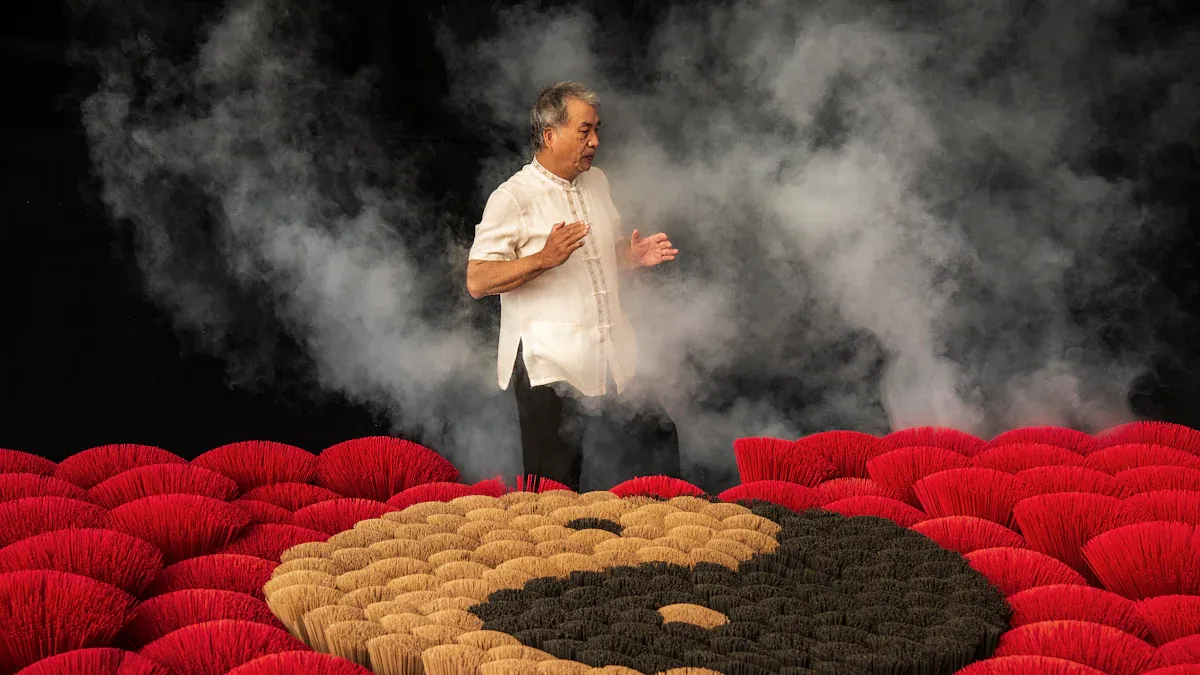
The Taiji diagram is a circle split by a flowing S-curve into two teardrop halves, one black and one white. The black half is yin: dark, cool, still, receptive. The white half is yang: bright, warm, active, assertive. Every part of the design carries meaning, and the symbol only makes sense when you read all of it at once.
The outer circle stands for wholeness, the Tao itself, before it divides into parts.
The S-curve, not a straight line, shows that yin and yang flow into each other rather than sitting in fixed halves.
The seed dot in each half means nothing is ever pure. Deep in yin there is a point of yang, and the reverse, so each force already contains its opposite.
The whole image reads as motion. Yin grows as yang fades, the way night follows day, then turns back again.
The graphic itself is relatively recent, popularized around the Song dynasty roughly a thousand years ago, but the underlying idea of paired forces is far older and runs through the I Ching. For how this balance plays out in everyday wellbeing, our piece on yin-yang and mental health applies the symbol to stress and rest.
What It Teaches
The lesson of the Taiji diagram is that opposites are partners, not enemies. Day and night, work and rest, effort and ease: each pair depends on the other to exist, and neither is good or bad on its own. Problems arise from imbalance, not from one side itself. Too much yang burns out; too much yin stagnates.
Because the seed dots show that each force is already turning into the other, the symbol also teaches that change is constant and natural. You cannot freeze life in a single state, and trying to is the source of much strain. When yin and yang move freely, qi, the vital energy, flows smoothly, which Taoism links to health and calm.
Tip: When you see the Taiji on jewelry or decor, read it as a reminder to rebalance rather than as a fixed badge. Its whole point is that the balance keeps shifting.
The Bagua: Eight Trigrams Around the Center

How the Trigrams Are Built
If the Taiji shows one pair of forces, the Bagua shows how that pair multiplies. Each trigram is a stack of three lines. A solid line is yang; a broken line is yin. With three positions and two choices each, you get exactly eight combinations, which is why there are eight trigrams. Stack two trigrams and you get the sixty-four hexagrams of the I Ching.
The Bagua appears in two classic arrangements. The Earlier Heaven (Fuxi) order places opposite forces across from each other to show cosmic balance. The Later Heaven (King Wen) order, the one used in feng shui, arranges the trigrams to show how energy moves through the cycle of the seasons and daily life. Each trigram ties to a compass direction, one of the five elements, and a member of the family, which is how the symbol connects abstract forces to real places and people.
Meaning of Each Trigram
Here is the standard Later Heaven set of correspondences. Qian is pure yang, three solid lines, and Kun is pure yin, three broken lines; the other six mix the two.
Trigram |
Symbol |
Meaning |
Direction |
Element |
Family Role |
|---|---|---|---|---|---|
Qian |
☰ |
Heaven, creativity, strength |
Northwest |
Metal |
Father |
Kun |
☷ |
Earth, nurturing, devotion |
Southwest |
Earth |
Mother |
Zhen |
☳ |
Thunder, movement, growth |
East |
Wood |
Eldest Son |
Xun |
☴ |
Wind, gentleness, flexibility |
Southeast |
Wood |
Eldest Daughter |
Kan |
☵ |
Water, depth, mystery |
North |
Water |
Middle Son |
Li |
☲ |
Fire, clarity, brightness |
South |
Fire |
Middle Daughter |
Gen |
☶ |
Mountain, stillness, stability |
Northeast |
Earth |
Youngest Son |
Dui |
☱ |
Lake, joy, openness |
West |
Metal |
Youngest Daughter |
Reading the table, you can see the logic. Qian and Kun anchor the set as pure yang and pure yin, the father and mother, and the six children sit between them as different blends of the two. The element and direction columns are what feng shui practitioners use to map a home, which we walk through in the guide to measuring your feng shui house direction.
Note: The element ties also connect the Bagua to the wider five-element system. If you want to know your own dominant element, see our breakdown of the five-element personality types.
How the Two Symbols Work Together
The Taiji and the Bagua are not separate ideas but two zoom levels of one idea. Start with the Tao, the undivided whole. It splits into yin and yang, which the Taiji diagram pictures. Those two forces then combine in threes to make the eight trigrams of the Bagua, and the trigrams pair up into the sixty-four hexagrams that the I Ching uses to describe any situation. It is one system viewed at finer and finer grain.
This is why you so often see them drawn together, the Bagua ringing a Taiji at its center. The center is the source; the ring is everything the source produces. In practice the pair shows up across Chinese culture: in feng shui maps, in traditional medicine that reads the body through the same forces, and in the martial art of Baguazhang, whose circular footwork is built on the eight trigrams.
Featured for This Reading
Pieces That Carry This Intention
Yin-yang and five-element pieces, for when the idea needs something to hold.


FAQ
What is the difference between the Taiji diagram and the yin-yang symbol?
They are the same image. Taiji diagram, taijitu, and yin-yang symbol all name the swirling black-and-white circle. The word taiji means the supreme ultimate, the whole that divides into yin and yang.
Why does the Bagua have exactly eight trigrams?
Each trigram has three lines, and each line is either yang (solid) or yin (broken). Three positions with two options each give two to the third power, which is eight possible combinations.
What is the difference between the two Bagua arrangements?
The Earlier Heaven (Fuxi) Bagua shows ideal cosmic balance, with opposites facing each other. The Later Heaven (King Wen) Bagua, used in feng shui, shows how energy actually moves through the seasons and daily life.
How are the trigrams connected to the five elements?
Each trigram links to one of the five elements, wood, fire, earth, metal, or water, along with a direction. Feng shui uses these ties to map a home and balance the energy of each area.
Where do these symbols appear in daily life?
You will find the Taiji and Bagua on jewelry, teaware, and home decor, on feng shui maps, in traditional Chinese medicine, and in the martial art Baguazhang, whose moves follow the eight trigrams.