
Taoism Symbols: 7 Essential Meanings Explained

The seven core Taoist symbols are the yin-yang (Taijitu), the Bagua, the five elements (wuxing), the Lo Pan compass, the Neijing Tu (Inner Scene Diagram), the Guodian Bamboo Slips, and the Dragon and Phoenix. Each one encodes a single idea that runs through all of Taoism: that opposites hold each other in balance, and that Qi (气) flows best when nothing is forced. This guide walks through all seven, what each symbol means, where it came from, and how people still use it today.
Key Takeaways
The yin-yang symbol is the foundation. It teaches that activity and rest, light and dark, are two halves of one whole, and that health comes from keeping them in balance.
The Bagua maps eight forces of nature onto your life. In feng shui it becomes a grid you lay over your home to direct energy toward work, health, and relationships.
The five elements explain how change moves. Wood, fire, earth, metal, and water feed and check each other in a cycle that underpins Chinese medicine and feng shui alike.
The Lo Pan compass turns theory into direction. Feng shui masters use its rings to align a building with favorable energy.
The Dragon and Phoenix pair masculine and feminine. Together they stand for union, harmony, and good fortune, which is why they appear at Chinese weddings.
Yin and Yang: The Foundational Taoist Symbol
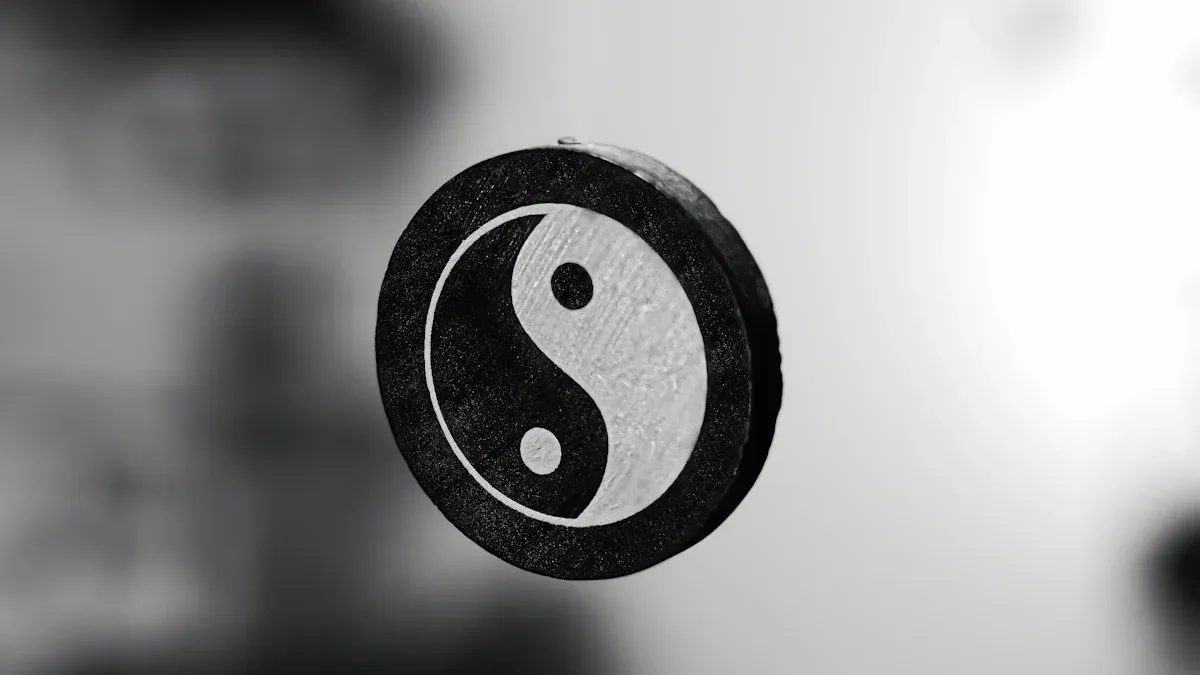
What the Yin-Yang Symbol Means
The yin-yang symbol, properly called the Taijitu, is the most recognized symbol of Taoism. Two swirling halves, one black and one white, each carry a dot of the opposite color. That small dot is the whole point: nothing is ever purely one thing. Yin is the quality of darkness, rest, cold, and inward movement. Yang is brightness, activity, heat, and outward movement. Neither is good or bad. They define each other, the way a valley only exists because of the hills around it.
The vocabulary is older than Taoism itself. The terms first described the shady and sunny sides of a hill, and they appear in oracle bone inscriptions dating back to at least the 14th century BCE. The table below traces where the idea comes from.
Term |
Description |
|---|---|
Yin |
Originally the shaded side: a closed door, darkness, the north slope of a mountain. |
Yang |
Originally the lit side: height, brightness, the south slope of a mountain. |
Origin |
Found in oracle bone inscriptions dating to at least the 14th century BCE. |
First paired use |
Appears in the Book of Songs, describing the sunny and shady sides of a hill. |
Why Balance Is the Hidden Power
The reason the symbol endures is that it is also a model of health. Traditional Chinese Medicine reads the body as a system that works when yin and yang stay in dynamic equilibrium and breaks down when one side overwhelms the other. Too much yang shows up as heat, agitation, and inflammation. Too much yin shows up as cold, fatigue, and sluggishness. Treatment, in that framework, means restoring the balance rather than attacking a single symptom. The same logic explains why the symbol still resonates outside China: most people recognize the experience of pushing too hard for too long and paying for it later.
Using Yin and Yang in Daily Life
People apply the symbol as a simple rule of pacing. After a demanding, high-output stretch (yang), they deliberately add something restorative (yin) instead of pushing straight into the next task.
Follow a morning of meetings with ten minutes of slow breathing or a short walk.
Pair a brisk workout with an evening of reading or a warm bath.
Build both effort and recovery into the same workday rather than saving rest for the weekend.
Practice Qigong during transitions, such as dusk, to settle an overstimulated nervous system.
For a closer look at how this symbol fits with the Bagua and the wider visual language of Taoism, read Taiji Diagram and Bagua: What These Taoist Symbols Mean.
The Bagua: Eight Trigrams of Change
What the Bagua Is
The Bagua is a set of eight trigrams, each built from three stacked lines that are either solid (yang) or broken (yin). Eight combinations cover the full range from pure yang to pure yin, and each one names a force of nature and a member of a symbolic family. Think of it as the alphabet that the I Ching uses to describe how situations shift from one state into another.
☰ Qian: Heaven, strength, the father
☱ Dui: Lake, joy, the youngest daughter
☲ Li: Fire, clarity, the middle daughter
☳ Zhen: Thunder, movement, the eldest son
☴ Xun: Wind, gentleness, the eldest daughter
☵ Kan: Water, depth, the middle son
☶ Gen: Mountain, stillness, the youngest son
☷ Kun: Earth, receptivity, the mother
What the Bagua Teaches
Read as a whole, the Bagua is a language of opposites in motion. It shows how yin and yang combine with the five elements to produce every kind of change, and it links those forces to concrete areas of a life. The table below maps the main associations.
Area of Life |
What It Governs |
|---|---|
Family |
Relationships and the bonds between members of a household. |
Health |
Vitality and physical well-being. |
Wealth |
Prosperity and the capacity to accumulate. |
Balance |
The harmony of opposing forces across the whole. |
Divination |
Reading current conditions to anticipate change. |
Using the Bagua at Home
In feng shui, the Bagua becomes a practical tool. You lay a three-by-three grid over your floor plan, aligned with the front door, and each cell corresponds to a life area such as career, relationships, or health. Adjusting what sits in each zone, a desk in the career corner, plants in the health corner, is meant to keep Qi moving rather than stagnating. For a room-by-room walkthrough, see our Bagua Map 2026 Fire Horse Feng Shui Guide. (You can also explore Bagua pieces made for this purpose.)
Tip: Do not try to optimize all nine zones at once. Pick the one life area that feels most stuck, clear the clutter in that part of your home first, and live with the change for a couple of weeks before touching the next zone.
The Five Elements: How Change Cycles
What the Five Elements Are
The five elements, or wuxing, are water, fire, wood, metal, and earth. They are less like physical substances and more like five phases that energy passes through. Classical texts such as the Shujing treat them as the basic categories for reading patterns in nature and society. The table below gives each element's character and a classic association.
Element |
Character |
Classic Association |
|---|---|---|
Water |
Moistens and descends |
Saltiness |
Fire |
Burns and ascends |
Bitterness |
Wood |
Bends and straightens |
Sourness |
Metal |
Yields and reshapes |
Pungency |
Earth |
Receives and gives |
Sweetness |
The Hidden Power: Two Cycles
The elements gain their meaning from how they relate. In the generating cycle they feed one another: water nourishes wood, wood fuels fire, fire creates ash that becomes earth, earth yields metal, and metal collects water. In the controlling cycle they check one another, so that no single element runs away unchecked. That pairing of support and restraint is the whole model of balance. Chinese medicine uses the same cycles to map organ relationships and choose treatments. For the full breakdown, read What Are the Five Elements in Feng Shui and What Do They Mean.
Applying the Elements to Yourself
Many people use the elements as a personality lens. You identify your dominant element, notice what it tends to over- or under-supply, and lean on a complementary element to rebalance. A water-dominant person who tends toward indecision, for example, benefits from the drive of fire. Our guide to Five Element Theory and personality covers how to find yours. A simple daily version looks like this:
Morning: stand barefoot outside (earth) and drink water.
Midday: do a few minutes of breathwork and eat cooling foods (fire).
Evening: stretch or journal (wood), then sit quietly to settle all five.
(Explore our Five Elements Collection for pieces tied to each phase.)
The Lo Pan Compass: Feng Shui in a Disk
What the Lo Pan Compass Is
The Lo Pan is the working instrument of feng shui. It is a round plate of concentric rings around a central magnetic needle, and each ring encodes a layer of information about direction, the trigrams, the elements, and time. Where the yin-yang and the Bagua are concepts, the Lo Pan is the device that turns them into a precise reading of a site.
The compass evolved over centuries. Early Han-dynasty diviners used a south-pointing spoon, and later feng shui masters added rings encoding their formulas until the instrument reached its modern form, built around an Inner Plate, an Outer Plate, and the central Heaven's Pool that holds the needle.
Period |
Development |
|---|---|
Han dynasty (from 206 BCE) |
A south-pointing spoon used for divination. |
Later refinement |
Became a ringed compass carrying feng shui formulas. |
Key components |
Inner Plate, Outer Plate, Heaven's Pool, and a magnetic needle. |
How It Is Used
A practitioner aligns the needle, then reads the rings to find favorable orientations for a building or a room. The widely used "Twenty-Four Mountains" ring divides the full circle into directions tied to the trigrams and elements, which is how a master decides which way a door or a desk should face. The Lo Pan does not replace the other symbols; it combines the Bagua and the five elements into one set of coordinates.
The Neijing Tu: Inner Alchemy Mapped on the Body
What the Inner Scene Diagram Is
The Neijing Tu, or Inner Scene Diagram, is a Taoist chart that pictures the inside of the body as a landscape. It appeared in Taoist art during the Song and Ming dynasties and uses images and verse, rather than anatomy, to describe how internal energy circulates. It is a meditation map: a guide for the inward work of neidan, or inner alchemy.
What It Teaches
The diagram personifies the organs and links them to the cosmos. The heart sits as the ruler, the other organs serve as officials, and the five principal organs correspond to five planets. The point is to show energy as something that can be cultivated and refined in stages.
Symbol |
Meaning |
|---|---|
Heart |
The ruler of the body. |
Other organs |
Officials serving the ruler. |
Five zang organs |
Correspond to the five planets. |
It also lays out the classic stages of inner alchemy: refining essence (jing) into Qi, Qi into spirit (shen), spirit back into emptiness, and emptiness into union with the Tao. In practice, students approach this through Qigong, Tai Chi, and standing meditation (zhan zhuang) rather than through the diagram alone.
The Guodian Bamboo Slips: The Oldest Tao Te Ching
What They Are
The Guodian Bamboo Slips are bamboo strips excavated in 1993 from a tomb in Guodian, Hubei, and dated to around 300 BCE. They contain the earliest known portions of the Tao Te Ching, alongside texts that blend Taoist and Confucian thought, which is why scholars treat them as a window into early Chinese philosophy before the traditions hardened into separate schools.
Aspect |
Detail |
|---|---|
Discovery |
Found in 1993 in a tomb in Guodian, Hubei. |
Date |
Around 300 BCE. |
Content |
71 slips matching portions of 31 Tao Te Ching chapters. |
Significance |
Earliest known version of the text, with notable variants from later editions. |
Why They Matter Today
The Guodian text differs in wording from the later Wang Bi and Mawangdui versions, which lets scholars see how the Tao Te Ching was edited over time. For readers, the slips are a reminder that these ideas are genuinely ancient and were already being copied, taught, and debated more than two thousand years ago. They emphasize self-cultivation and harmony with the Tao over rules and ritual.
The Dragon and Phoenix: Union of Opposites
What They Mean
The dragon and the phoenix are the most ornamental of the Taoist symbols, and as a pair they restate the yin-yang idea in living form. The dragon carries yang: strength, power, and the masculine. The phoenix carries yin: beauty, grace, and the feminine. Apart they are impressive; together they signify union, balance, and good fortune, which is why the pairing is a fixture at Chinese weddings.
The dragon stands for strength, power, and the yang principle.
The phoenix stands for beauty, renewal, and the yin principle.
Together they signify a balanced union and lasting good luck.
How the Pair Is Used
In Taoist practice the two appear on amulets, art, and clothing, and they serve as focal points in meditation on balancing Qi. In the home, dragon-and-phoenix imagery is placed to invite harmony and fortune, especially for couples. The pairing keeps the same message as the yin-yang symbol, that wholeness comes from two complementary forces rather than one.
Featured for This Reading
Pieces That Carry This Intention
Yin-yang and five-element pieces, for when the idea needs something to hold.


FAQ
What are the main symbols of Taoism?
The core Taoist symbols are the yin-yang (Taijitu), the Bagua of eight trigrams, the five elements (wuxing), the Lo Pan compass, the Neijing Tu, the Guodian Bamboo Slips, and the Dragon and Phoenix. Each expresses balance and the flow of Qi in a different way.
What is the most important Taoist symbol?
The yin-yang symbol is the most important and the most recognized. It captures the central Taoist idea that opposites depend on each other and that balance, not dominance, produces health and harmony.
What does the yin-yang symbol actually mean?
It shows two forces, yin and yang, as halves of a single whole, each containing a seed of the other. Yin is rest, dark, and cool; yang is activity, light, and warm. The symbol teaches that the two must stay in balance.
How is the Bagua used in feng shui?
The Bagua becomes a three-by-three grid laid over a floor plan and aligned with the front door. Each cell maps to a life area, and arranging objects within those zones is meant to keep energy flowing toward goals like health, wealth, and relationships.
Are Taoist symbols religious or philosophical?
They are both. Symbols like the yin-yang and the five elements belong to philosophical Taoism as models of how the world works, while religious Taoism also uses them in ritual, divination, and inner alchemy.
See Also
- Taiji Diagram and Bagua: What These Taoist Symbols Mean
- What Are the Five Elements in Feng Shui and What Do They Mean
- What Is Qi (Chi) in Taoism? A Beginner's Guide
- Bagua Map 2026 Fire Horse Feng Shui Guide
- Five Element Theory: What Your Wu Xing Personality Reveals
About This Article
Written by Li Wei. Reviewed by the Taoism & Manifest editorial team.
Sources: This article draws on classical Taoist tradition and the reference sources linked in the text above.
Scope: Taoist symbols carry meanings that vary across regions, lineages, and historical periods. This guide presents widely shared interpretations for cultural education, not religious authority.