
One God or Many? The Truth About Taoist Theology
Serena Jones
Does Taoism believe in one god or many? Neither answer fits cleanly. At its center, Taoism is built around the Tao, and the Tao is not a god at all. It is the source and pattern behind everything, impersonal and nameless. Religious Taoism does honor a large pantheon of deities, but those gods serve and express the Tao rather than rule over it. To understand Taoist theology, you have to set aside the monotheism-or-polytheism question and look at what the tradition actually teaches.
Key Takeaways
The Tao is the foundation, not a deity. It is the impersonal source of the universe, without will, form, or voice.
There are two strands of Taoism. Philosophical Taoism centers on living in accord with the Tao; religious Taoism adds gods, temples, and ritual.
Taoist deities have functions, not dominion. They help people connect with spiritual forces but never replace the Tao.
Practice matters as much as belief. Meditation, Tai Chi, and Qigong are central ways of aligning with the Tao.
Taoism resists Western categories. It is neither monotheistic nor straightforwardly polytheistic, because the Tao is a principle rather than a personal god.
The Tao: Ultimate Principle, Not a God
The Tao is the central idea of Taoism, and it is not a god with a body, a personality, or desires. It does not speak, judge, or intervene. It is the origin from which everything arises and the order that runs through all of nature. The Tao Te Ching opens by saying the Tao gave rise to heaven and earth, and Lao Tzu describes it as something that came before any conception of a deity:
The Tao that can be told is not the eternal Tao. The name that can be named is not the eternal name. Nameless, it is the origin of heaven and earth. Named, it is the mother of ten thousand things.
Because the Tao is impersonal, people do not worship it the way believers worship a personal god. They align with it. It is always present and always at work, supporting life without ruling it. That is the first thing to understand about Taoist theology: the most important reality in the tradition is not a god at all.
Philosophical and Religious Taoism
Taoism runs in two broad streams. Philosophical Taoism, rooted in the Tao Te Ching and the Chuang Tzu, treats the Tao as the source of everything and asks people to live simply and in harmony with nature. It makes no demand that you believe in gods. Religious Taoism, which developed over centuries, adds a structured pantheon, temples, priests, and ritual. Its gods are organized almost like a celestial bureaucracy, each with a defined role.
At the top sit the Three Pure Ones, who embody the highest aspects of the Tao. Below them are ordered ranks of deities responsible for particular domains of nature and human life. The structure mirrors the imperial administration of old China, which is part of why these gods are understood as officials carrying out the order of the cosmos rather than rival supreme beings.
Aspect |
Description |
|---|---|
Taoist vs. folk spirits |
Taoist deities are seen as expressions of the pure Tao, distinct from local folk spirits that bargain for offerings. |
Coexistence and rivalry |
Historical records show Taoist and folk gods sometimes cooperating and sometimes competing, reflecting a blended religious landscape. |
Modern fieldwork |
Studies of village religion show Taoist, Buddhist, and folk practices living side by side rather than in opposition. |
Shared roles |
Taoist and Buddhist priests historically saw their work as complementary, serving the same communities. |
The key point is that no single all-powerful creator stands above this system the way God does in the Abrahamic religions. Everything traces back to the impersonal Tao, and the gods operate within that order. In practice, Taoism also leaves room for choice: people may honor deities, ancestors, or local spirits as they see fit. For a closer look at how Taoism sits alongside its neighbors, see our comparison of Buddhism and Taoism.
Taoist Deities and Their Roles
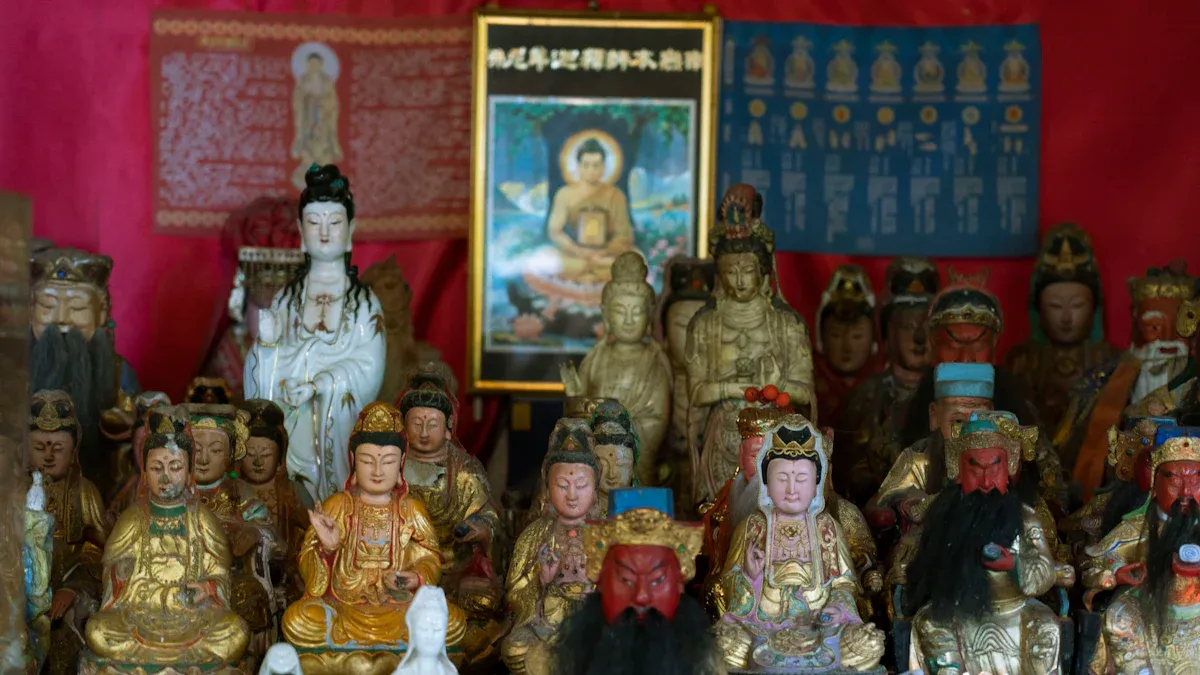
The Three Pure Ones and the Pantheon
In religious Taoism the deities give people a way to relate to forces that are otherwise abstract. The Three Pure Ones are the highest figures, rising to prominence in the fourth and fifth centuries CE through the Shangqing and Lingbao traditions and elevated further under the Tang dynasty. Each presides over a heaven and represents a stage of creation before the formed world. Beneath them, a wide array of gods and goddesses watch over harvests, families, cities, and the natural world.
Temples reflect these ideas in stone and setting. Sites in the Wudang Mountains and on Mount Qingcheng emphasize harmony with nature, while the White Cloud Temple and Louguantai honor Lao Tzu and the transmission of the Tao. Throughout, the teaching holds steady: the Tao stands above every deity, and the gods exist to help people draw closer to it.
Worship and Practice
Taoist worship combines ritual, offering, and personal cultivation. The large jiao ceremony asks the gods to bless a community and renew its bond with the cosmos. Many households keep a small shrine where they make offerings to deities and ancestors, an act that honors both family and the Tao. Temples stay open for prayer and incense, and ceremonies seek blessing, peace, and protection.
Alongside ritual, Taoism places heavy weight on practices that align body and mind with the Tao. Balancing rest and activity reflects yin and yang; Tai Chi and meditation lower stress and let energy move; clear boundaries between work and home preserve calm; and Wu Wei, effortless action, teaches people to stop forcing outcomes. For a practical treatment of that balance, see Yin and Yang in Daily Life.
Taoism Compared With Other Religions
How the Tao Differs From a God
What sets Taoism apart is its concept of the ultimate. In Christianity and Islam, God is a personal being who hears, wills, and acts. The Tao does none of this. It is impersonal, beyond full human understanding, and it guides nature without commanding it. Taoism does not propose a single supreme deity, nor does it tidily fit the label of polytheism, because its gods answer to a principle rather than the other way around. Attempts to file Taoism under monotheism or polytheism tend to miss what it is actually claiming. The table below sets the contrast side by side.
Aspect |
The Tao |
Gods in theistic religions |
|---|---|---|
Nature |
Impersonal principle |
Personal and willful |
Role |
Organizing source of all things |
Supreme creator or ruler |
Relationship to people |
Aligned with, not petitioned |
Worshipped and asked for help |
Structure |
No hierarchy |
Often a ranked order of beings |
Practice and Belief
Taoist practice also looks different from its neighbors. Where Buddhism and Hinduism foreground mindfulness, enlightenment, and the logic of karma, Taoism emphasizes harmony with the natural order, self-cultivation, and the balance of yin and yang. It blends readily with Chinese folk religion and prizes three virtues that Lao Tzu named: compassion, frugality, and humility. Self-cultivation, including the long quest for longevity, runs through its history, and merit comes from living well rather than from doctrine alone.
Taoism treats the Tao as the ultimate principle, not a personal god.
It emphasizes self-cultivation, balance, and harmony with nature.
Its core virtues are compassion, frugality, and humility.
Read this way, the old question dissolves. Taoism is not hiding a single god behind its many deities, and it is not simply a crowd of gods either. It is a tradition organized around an impersonal source, with deities who help people live in step with it.
Featured for This Reading
FAQ
What does the Tao mean in Taoism?
The Tao is the natural way and source of the universe. It is impersonal and cannot be seen or fully described, yet it underlies and orders all things. Taoists seek to align with it rather than worship it.
Does Taoism believe in one god or many gods?
Neither label fits well. The foundation of Taoism is the impersonal Tao, not a god. Religious Taoism honors many deities, but they serve the Tao instead of ruling as supreme beings.
What role do deities play in Taoism?
Taoist deities help people connect with spiritual forces and are honored through ritual and offering. They have defined functions within a cosmic order, and they never stand above the Tao.
What is the difference between philosophical and religious Taoism?
Philosophical Taoism centers on living in harmony with the Tao and makes no demand to believe in gods. Religious Taoism adds temples, priests, ritual, and a pantheon. Both share the same core idea of the Tao.
What makes Taoism different from other religions?
Its ultimate reality is a principle, not a person. The Tao does not will or command, which is why Taoism resists the usual monotheist and polytheist categories.