
Taoist Visualization Meditation: The Inner Landscape

Image Source: Pexels
Taoist visualization meditation is the practice most people skip because it sounds complicated. It is not. It asks one thing: instead of emptying the mind, you build a vivid inner world and learn to move through it. The Taoists mapped the body as a landscape — mountains, rivers, stars — and treated meditation as travel.
The short version: this practice, called cunxiang, is one of the oldest forms of Taoist meditation. It is the root of internal alchemy. And its core map, the inner landscape, turns your own torso into terrain you can explore.
Key Takeaways
- Visualization is constructive, not empty. Cunxiang builds vivid inner imagery rather than just watching the breath pass.
- The body is a landscape. The Neijing Tu diagram maps the torso as mountains, rivers, stars, and inner gods you can travel through.
- It predates and seeds neidan. Early visualization became the foundation of internal alchemy: Jing to Qi to Shen to the Dao.
- It is goal-directed. Intent guides energy along set pathways — different from receptive mindfulness.
- Start gentle. Calm inner imagery is safe solo; advanced energy circulation is sequential and needs a teacher.
What Taoist Visualization Meditation Actually Is

Image Source: Pexels
Taoist visualization meditation is the active branch of the tradition. The scholar Livia Kohn splits Taoist practice into three types: concentration (ding), insight (guan), and visualization (cun). Visualization is the one where you deliberately construct inner images and hold them, according to Taoist meditation scholarship dating practices to the Warring States period.
This is not a niche technique. The earliest Taoist movements — Great Peace, Great Clarity, and especially the Shangqing School — used it heavily. Practitioners concentrated on inner lights, visualized gods inside the body, and took ecstatic inner journeys to the stars. The third-century Scripture of the Yellow Court is probably the first text describing these inner spirits by name. So the practice is old, formal, and detailed — not improvised guided imagery. (For a gentler entry point, read Easy Ways to Practice Taoist Visualization Techniques in 2025.)
Note: Mindfulness lets images pass. Taoist visualization builds them on purpose, then works with them. If you have only ever "watched the breath," this is a different muscle.
The Inner Landscape: Reading the Neijing Tu

Image Source: Pexels
The inner landscape is the heart of advanced Taoist visualization meditation. The Neijing Tu is a Taoist diagram that draws the human body as terrain — a "diagram of interior lights." The pole star and the Northern Dipper stand for the heart. A buffalo ploughing the field of the elixir stands for the intestines. Mountains and rivers are organs and channels.
Why a map? Because the practice is travel. Ancient visualization charts exist to guide the adept through this interior country: visualizing the Five Beasts, journeying through the viscera, watching inner lights. The best-known Neijing Tu was engraved in 1886 on a stele at Beijing's White Cloud Temple, copied from an old silk scroll found on Mount Song. The body becomes a microcosm — the same stars outside are inside. (The body-as-sacred-vessel idea is explored in What is Lianxing in Taoism.) A grounding stone in hand can steady the gaze inward — many practitioners use pieces from our Obsidian Series as an anchor.
| Neijing Tu image | Inner meaning | Practice cue |
|---|---|---|
| Pole star / Dipper | The heart | Settle attention at chest center |
| Buffalo ploughing | The intestines, elixir field | Soften and warm the lower belly |
| Mountains and rivers | Organs and energy channels | Trace breath as flowing water |
| Inner gods | Living forces of the viscera | Hold each region with respect, not force |
From Visualization to Neidan: Where the Practice Leads

Image Source: Pexels
Taoist visualization meditation is the doorway to neidan, internal alchemy. Neidan transforms the Three Treasures in sequence: Jing (essence) into Qi (energy) into Shen (spirit), and finally into emptiness, the Dao. The body becomes a furnace and cauldron, "formed by the specific techniques of visualization and breathing." As the scholar Isabelle Robinet put it, inner alchemy begins where the gross breathing exercises end.
Concretely, intent (yi) guides energy along inner pathways. The great Taoist Qiu Chuji described sitting cross-legged, breathing through the nose, and circulating energy through the micro-orbit channels so the energies of heart and kidneys fuse. Attention typically gathers in the lower dantian first, then refines upward. (For the larger aim behind this, read The Real Goal of Taoism's Alchemy in Ancient China.)
The ending is quiet. When Qi stabilizes, Shen arises — luminous, formless awareness. The adept observes without a subject, and spirit dissolves "like mist at dawn." That is the elixir: not a substance, a lived return to the Dao.
A Safe Beginner Version You Can Do Tonight
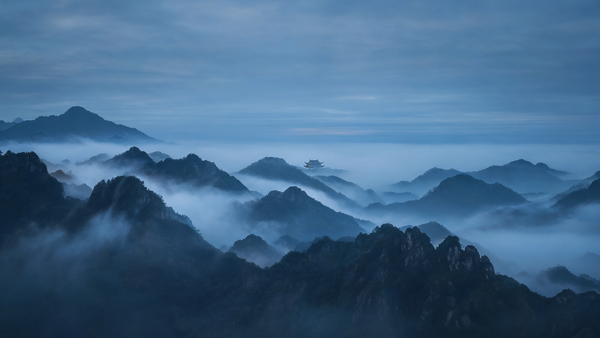
You do not need the full system to start Taoist visualization meditation. Keep it to the calm, foundational layer. Sit comfortably. Relax the body in waves from crown to feet. Rest attention two inches below the navel — the lower dantian. Now picture, gently, a still inner landscape there: a quiet valley, a slow river, soft light. Do not strain the image. Let it form the way scenery appears through clearing fog.
Breathe as if the river is the breath, flowing in and out without a push. Five to ten minutes is enough. The point at this stage is steadiness and inner seeing, not energy circulation — that comes later, sequentially, and traditionally with a teacher. (To pair this with classic inner-peace methods like the Inner Smile, read Ancient Taoist meditation for inner peace.)
Tip: If the inner image keeps collapsing, stop forcing it. Drop back to the breath-as-river for a few cycles, then let the landscape return on its own. Construction without strain is the whole skill. A focusing stone for "inner vision" can help — see Lapis Lazuli Meaning: Taoist Stone for Truth & Vision.)
Practiced lightly and often, the inner landscape stops being a metaphor. It becomes a place you know how to enter — which is exactly what the old maps were for.
Featured for This Reading
Pieces That Carry This Intention
Beads meant to be handled while you practice, not just worn.


Frequently Asked Questions
What is Taoist visualization meditation?
It is a traditional practice called cunxiang, in which the meditator holds vivid inner images of energies, lights, and inner beings rather than just watching the breath. It predates the Shangqing school and became the seed of neidan, internal alchemy.
What is the inner landscape in Taoism?
The inner landscape is the body imagined as terrain: mountains, rivers, stars, and inner gods. The famous Neijing Tu diagram maps it this way, turning the torso into a scene the meditator can travel through during practice.
How is this different from mindfulness meditation?
Mindfulness watches what arises and lets it pass. Taoist visualization actively builds and directs inner imagery, then circulates energy along set pathways. It is constructive and goal-directed, not purely receptive.
Can a beginner practice the inner landscape method?
A simple version is safe: relax, settle attention in the lower dantian, and picture a calm landscape inside the body. The advanced neidan stages of energy circulation are sequential and traditionally need a qualified teacher.
Is Taoist visualization meditation safe to do alone?
Gentle imagery and breath settling are fine alone. Forcing advanced energy circulation without preparation is, in the words of classical sources, at best inefficient and at worst risky. Keep solo practice to the calm, foundational layer.