

Feng Shui House Numbers: Meanings of 1 to 9 (Guide)
Michael Chen
To find your feng shui house number, add the digits of your address together and keep reducing until you reach a single number from 1 to 9. That digit carries the energy feng shui reads in your home. In the most common reading, 1, 2, 3, 6, 8, and 9 are treated as auspicious, while 4, 5, and 7 are seen as harder numbers that ask for a little extra care. None of them is a verdict. A number sets a tendency, and how you live in the space matters far more than the digit on the door.
Most of this comes from Chinese numerology, where numbers are lucky or unlucky largely because of how they sound. This guide shows you how to calculate your number, what each one means, why cultures disagree about them, and what to do if yours feels off.
Key Takeaways
Add the digits of your full house number and reduce to a single digit. That number is the one feng shui reads for your home's energy.
The usual split treats 1, 2, 3, 6, 8, and 9 as favorable and 4, 5, and 7 as more demanding, mostly because of how the numbers sound in Chinese.
Each digit links to a bagua area and a natural element, which tells you which part of life it leans toward.
Lucky and unlucky are cultural, not fixed. The number 4 is avoided across much of East Asia but neutral elsewhere.
No house number is doomed. Light, plants, a clean entrance, and the right colors shift the energy of any address.
How to Calculate Your Feng Shui House Number
The Reduction Method
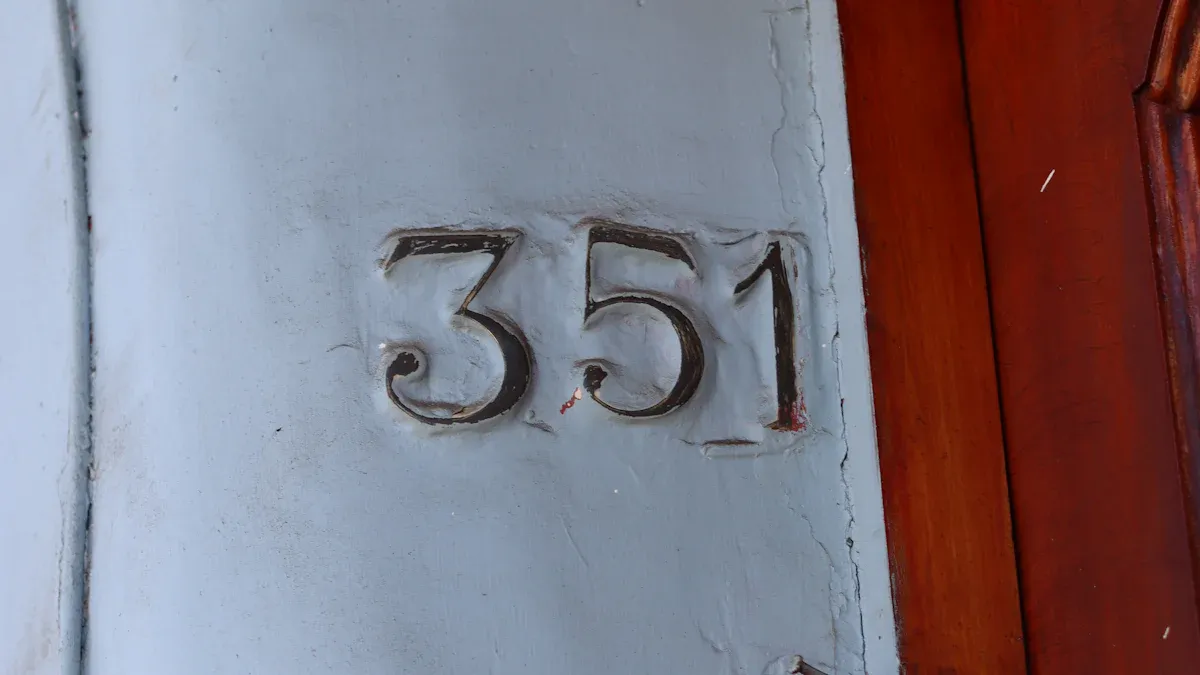
The calculation is the same digit-summing used in numerology. You collapse a long number down to one root digit, because that root is the energy feng shui actually reads:
Write out your full house number.
Add every digit together.
If the total has more than one digit, add those digits too.
Repeat until a single digit, 1 through 9, is left.
Letters in an address, like 12B, are usually dropped, and apartment numbers are read the same way as house numbers. If your unit number feels more like your home than the building number, use the one you actually live behind.
Worked Examples
Three quick examples cover almost every address you will meet:
Number 7 is already a single digit, so its number is 7.
Number 22 reduces to 2 + 2 = 4.
Number 2665 reduces to 2 + 6 + 6 + 5 = 19, then 1 + 9 = 10, then 1 + 0 = 1.
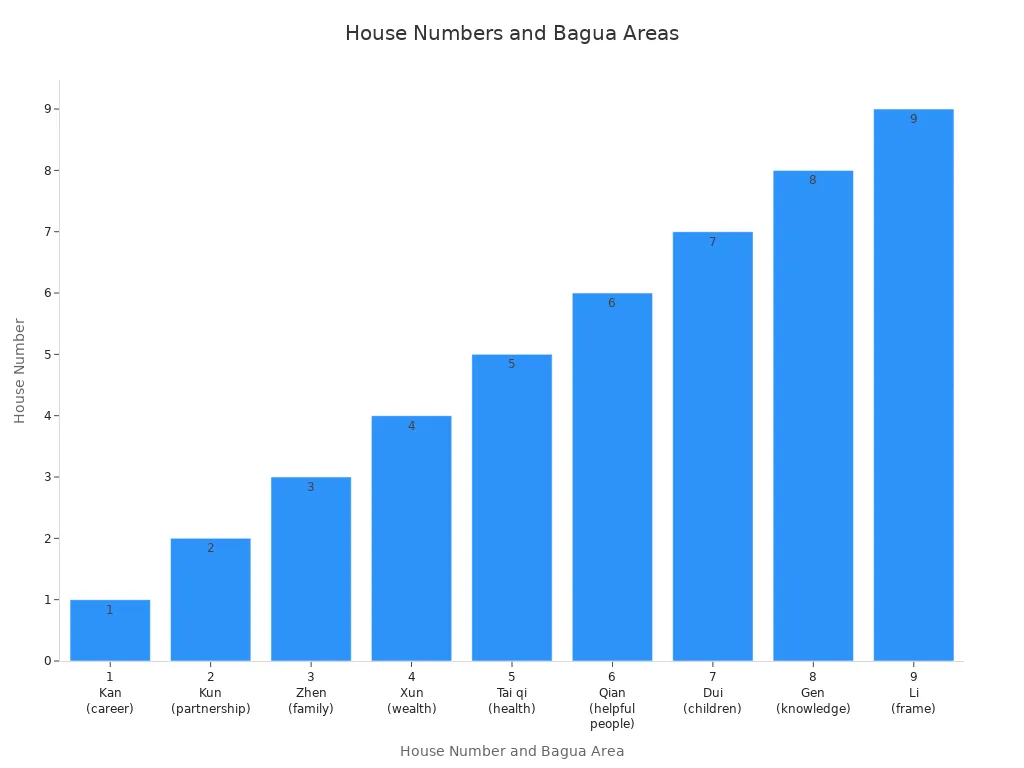
Once you have the root digit, the bagua tells you which life area and element it leans toward. The table below pairs each number with its bagua house and element, which is what turns a digit into a meaning you can use.
Number |
Meaning |
Bagua Area |
Element |
|---|---|---|---|
1 |
New beginnings |
Kan (career) |
Water |
2 |
Partnership |
Kun (relationships) |
Yin Earth |
3 |
Self-expression |
Zhen (family) |
Yang Wood |
4 |
Stability |
Xun (wealth) |
Yin Wood |
5 |
Change |
Tai Qi (center) |
Earth |
6 |
Calm and support |
Qian (helpful people) |
Yang Metal |
7 |
Reflection |
Dui (children) |
Yin Metal |
8 |
Abundance |
Gen (knowledge) |
Yang Earth |
9 |
Completion |
Li (fame) |
Fire |
If you want to lay this grid over your actual floor plan, our guide on how to measure your feng shui house direction shows how to combine your number with the direction your home faces.
What Each House Number Means
Numbers 1 to 5
The first five numbers move from fresh starts toward grounding and change. One suits new chapters and independence, which makes it a strong fit for a first home or a home office where you set your own direction. Two softens a space toward partnership and calm, so couples and anyone craving a gentler home tend to settle well in it. Three carries creative, social energy and often draws people who make or perform. Four reads as stable and supportive in feng shui terms, yet much of East Asia avoids it for reasons of sound rather than energy, which the next section explains. Five sits at the center of the five-element cycle and brings movement, so it favors people who like change and unsettles those who want routine.
Tip: A number 2 home strengthens when you place objects in pairs, two lamps, two chairs, two plants, which echoes the partnership energy the digit already carries.
Numbers 6 to 9
The upper numbers lean toward support, reflection, wealth, and completion. Six is steady and nurturing, a number families and caregivers respond to, and it answers well to earth tones and family photos near the entrance. Seven turns inward toward thought and quiet, rewarding people who value solitude and meditation while feeling lonely to those who want a buzzing household. Eight is the prize of Chinese numerology, tied to wealth and flow because it sounds like the word for prosperity, which is why 8 commands premiums on addresses and license plates. Nine signals completion and achievement, a fitting number for someone closing one chapter and ready to begin another. If number 8 drew you here, our walkthrough on finding your feng shui wealth corner turns that energy into a spot you can actually activate.
Lucky and Unlucky Numbers Across Cultures
Whether a number is lucky depends on the language it is heard in, not on the number itself. In Mandarin and Cantonese, many number meanings come from homophones, words that sound alike. Eight (bā) echoes the word for wealth, so it is prized. Four (sì) sounds close to the word for death, so it is avoided so widely that the fear has its own name, tetraphobia. Buildings across China, Japan, Korea, and beyond skip the 4th floor the way some Western buildings skip the 13th.
Number |
Common Reading |
Why |
|---|---|---|
8 |
Very lucky |
Sounds like "wealth" or "prosper" |
6 |
Lucky |
Sounds like "flow" or "smooth" |
9 |
Lucky |
Sounds like "long-lasting" |
4 |
Avoided |
Sounds like "death" |
7 |
Mixed |
Spiritual but isolating; lucky in the West |
The takeaway is practical. A number that reads as heavy in one culture can be neutral or even fortunate in another, so a 7 that worries a buyer in one country sells at a premium in another. Read your own number through the meaning that matters to you, then shape the home to match the life you want in it.
How to Improve a Difficult House Number
Cures at the Entrance
If your number feels off, the front door is where you fix it, because feng shui treats the entrance as the mouth where Qi enters the home. A classic remedy is to set the house number inside a circle or oval on the door or mailbox, which softens a harsh digit and helps the number read as whole. From there, a few entrance habits do most of the work:
Keep healthy green plants by the door to bring living energy to the threshold.
Light the entrance well, since bright, warm light draws good Qi and lifts a dim address.
Clear clutter from the doorway so energy flows in instead of snagging.
Display the number clearly and in good repair, which lets the home register as cared for.
Note: Remedies do not erase a number's meaning. They tilt the energy toward balance, the way good light and fresh air change how any room feels regardless of its address.
Match Colors and Elements to Your Number
Each number's element points you toward colors and materials that support it. A number 1 home (Water) likes blues, blacks, and a small water feature. A number 8 home (Earth) strengthens with earth tones, crystals, and grounding stones. A harder number softens when you add the element it lacks, so a restless 5 calms with steady earth pieces, and a lonely 7 warms with the wood and fire of plants and soft lighting. A bagua map near the entrance keeps the number-to-element link in view while you arrange. For the deeper layout once your number is set, pair this with our feng shui chart guide, and if your number leans toward wealth, the money corner colors and elements guide shows which tones to add.
Featured for This Reading
FAQ
What if my house number is considered unlucky?
No number traps you. Set the number inside a circle on the door, keep the entrance bright and clear, and add the element your number lacks. These cures tilt the energy toward balance without changing your address.
How do I calculate my feng shui house number?
Add every digit of your house number, then keep adding the result until you reach a single digit from 1 to 9. Drop any letters. That final digit is the number feng shui reads for your home.
Do apartment numbers count the same as house numbers?
Yes. Reduce an apartment number the same way. If your unit number feels more like home than the building number, use the one you actually live behind.
Why is the number 8 so lucky in feng shui?
In Chinese, eight sounds like the word for wealth and prosperity, so it carries strong abundance energy. That homophone is why 8 commands a premium on addresses, phone numbers, and license plates.
Is feng shui house numbering different from numerology?
The digit-summing math is the same. Feng shui then ties that root number to a bagua area and an element in your home, while numerology focuses on the number's standalone meaning.