
Comparing Taoist Prayer Beads with Christian and Hindu Prayer Beads

Have you ever thought about how taoist prayer beads are different from Hindu malas and Christian rosaries? Every set of prayer beads has a special meaning. Each one is used in a unique way in its tradition.
Hindu malas have 108 beads. This number stands for holy books or gods.
Christian rosaries have a crucifix. They help you count prayers like the 'Hail Mary.'
The way these beads are made and used shows how cultures practice their faith.
As you read, think about which tradition matches your way of meditating or praying.
Key Takeaways
Prayer beads help you focus when you pray or meditate. They are tools that help you connect with something bigger than yourself.
Each religion has its own style of prayer beads. Hindu malas have 108 beads. Christian rosaries have 59 beads. Taoist prayer beads can have different numbers of beads.
Using prayer beads can help you feel calm and steady every day. You can use them to meditate, relax, or make quiet time for yourself.
The materials of prayer beads have special meanings. Pick beads made from wood, seeds, or stones that match your spiritual path.
Choosing prayer beads is a personal choice. Think about your goals and what feels good for your practice.
Prayer Beads: Similarities and Differences
Shared Purposes
You might notice that prayer beads, malas, and rosaries all help people connect with something greater. No matter which tradition you follow, these tools make it easier to focus during meditation or prayer. When you hold a mala or a string of prayer beads, you can count each bead as you repeat a word, a prayer, or a mantra. This simple act keeps your mind from wandering.
They help you stay focused during spiritual activities.
You can use them to count prayers or mantras.
Many people feel calm and grounded when they use them.
You do not have to belong to a certain religion to feel the benefits. Anyone can use these beads to find peace or to create a quiet moment in a busy day.
Distinct Traditions
Even though the purpose feels similar, each tradition has its own way of using prayer beads. You will see differences in the number of beads, the prayers or mantras, and the way people use them.
Religion |
Historical Origin |
Current Use |
|---|---|---|
Hinduism |
Ancient India, 8th century BCE |
Used for meditation and prayer, typically with 108 beads to mark cycles. |
Buddhism |
5th century BCE |
Adopted by followers in Tibet, China, and Japan. |
Christianity |
Middle Ages, 10th century AD |
Evolved from early practices using pebbles to the rosary, influenced by Crusaders. |
If you use a mala, you might practice Japa meditation. You choose a personal mantra and repeat it for each bead. This helps you concentrate and go deeper into meditation. A Christian rosary works differently. You follow a set order of prayers, like the Hail Mary, and move from bead to bead. The rosary usually has 59 beads, which connects to the Psalms.
Taoist prayer beads have their own story. They often show up in rituals or as part of daily life. You might see them used for counting breaths or reciting sacred texts. The number of beads and the way you use them can change depending on the practice.
Each tradition gives special meaning to its beads. Malas often have 108 beads, which stands for spiritual ideas in Hinduism. Rosaries have their own symbolism, shaped by Christian history. Taoist prayer beads reflect the values and beliefs of Taoism. When you pick up a set of beads, you hold a piece of history and culture in your hands.
Want to dive deeper into the differences between Taoist prayer beads and Hindu malas? Check out Prayer Beads vs. Mala Beads: Differences and Similarities for a detailed comparison.
Taoist Prayer Beads: Origins and Features
For those just starting their journey with Taoist prayer beads, Taoist Prayer Beads Explained for Beginners provides a thorough introduction.History and Symbolism
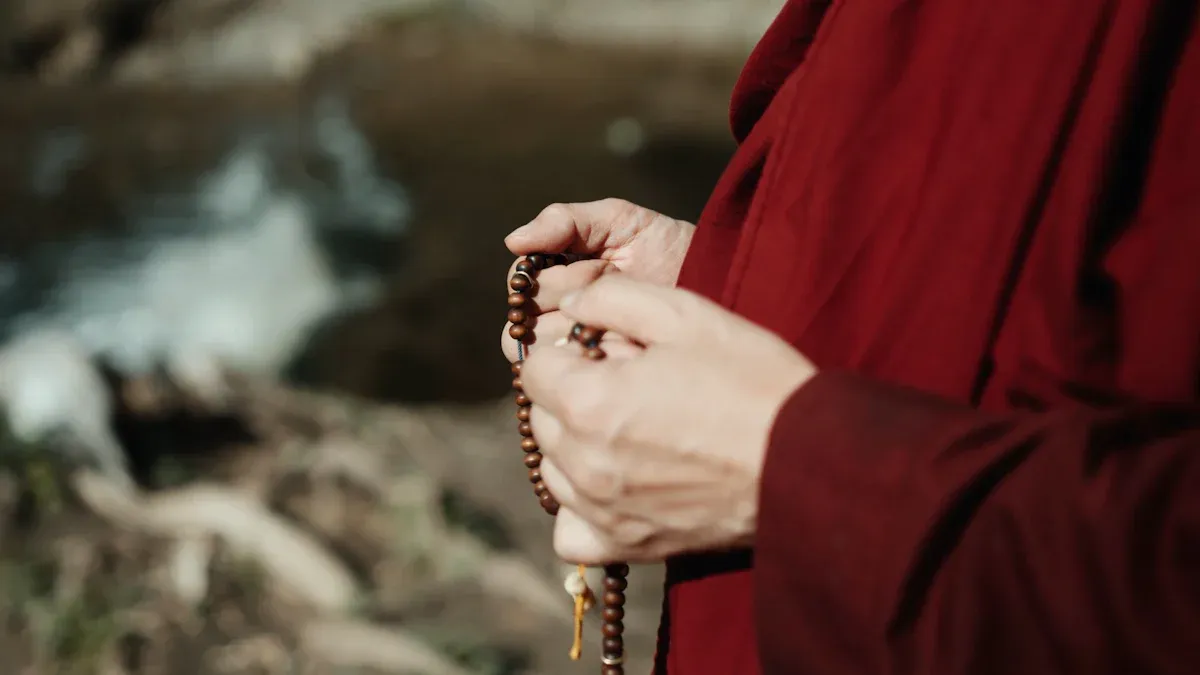
When you look at taoist prayer beads, you see more than just a string of beads. These beads have a long story that goes back to ancient China. People like farmers and monks used simple beads to count prayers or breaths. They wanted to keep track of chants and mantras during meditation. You might find it interesting that the Taoist text "Tai Shang San Yuan Liu Zhu Jing" talks about using 365 beads. This number stands for the days in a year. It shows that taoist prayer beads often connect daily life with spiritual practice.
Taoist prayer beads helped people focus on their breath.
Monks and laypeople used them to count sacred words.
Some bead sets matched the calendar, making each day special.
You can see how taoist prayer beads became a tool for both meditation and daily living. They remind you to stay present and mindful. If you want to learn more about how prayer beads changed over time, you might enjoy reading.
Materials and Bead Counts
Taoist prayer beads come in many shapes and styles. You will notice that the materials often have special meaning. Some people choose bodhi seeds or lotus seeds because they stand for wisdom and purity. Others pick stones like tiger’s eye or black onyx for their protective energy. You might even see lava rock or amazonite in some sets.
Here’s a quick look at the materials used in taoist prayer beads, mala beads, and rosaries:
Type of Beads |
Common Materials |
|---|---|
Taoist Prayer Beads |
Bodhi seeds, Amazonite, Lava rock, Lotus seeds, Tiger’s eye, Black onyx |
Mala Beads |
Wood, shell, amber, rudraksha, tulsi |
Rosaries |
Wood, bone, ivory, shiny stones |
When you count the beads, you will see more differences. Mala beads usually have 108 beads. This number is very important in Hinduism. Christian rosaries have a mix of small and large beads, each with its own meaning. Taoist prayer beads do not always have the same number. Some sets have 365 beads, while others use different counts for special rituals.
Religion |
Bead Count |
Significance |
|---|---|---|
Hinduism |
108 |
Used to count mantras during meditation; the number 108 holds spiritual meaning in Hinduism. |
Christianity |
54 + 5 |
Smaller beads for 'Hail Mary' prayers and larger beads for 'Our Father'; guides through prayers. |
Taoism |
Varies |
Bead counts can change based on the ritual or purpose, such as 365 beads for the days in a year. |
You can see that taoist prayer beads offer a lot of flexibility. You might choose a set that fits your daily routine or a special ritual. Mala beads, on the other hand, stick to the number 108. This makes each type of bead unique in its own way.
Mala and Rosary: Hindu and Christian Beads
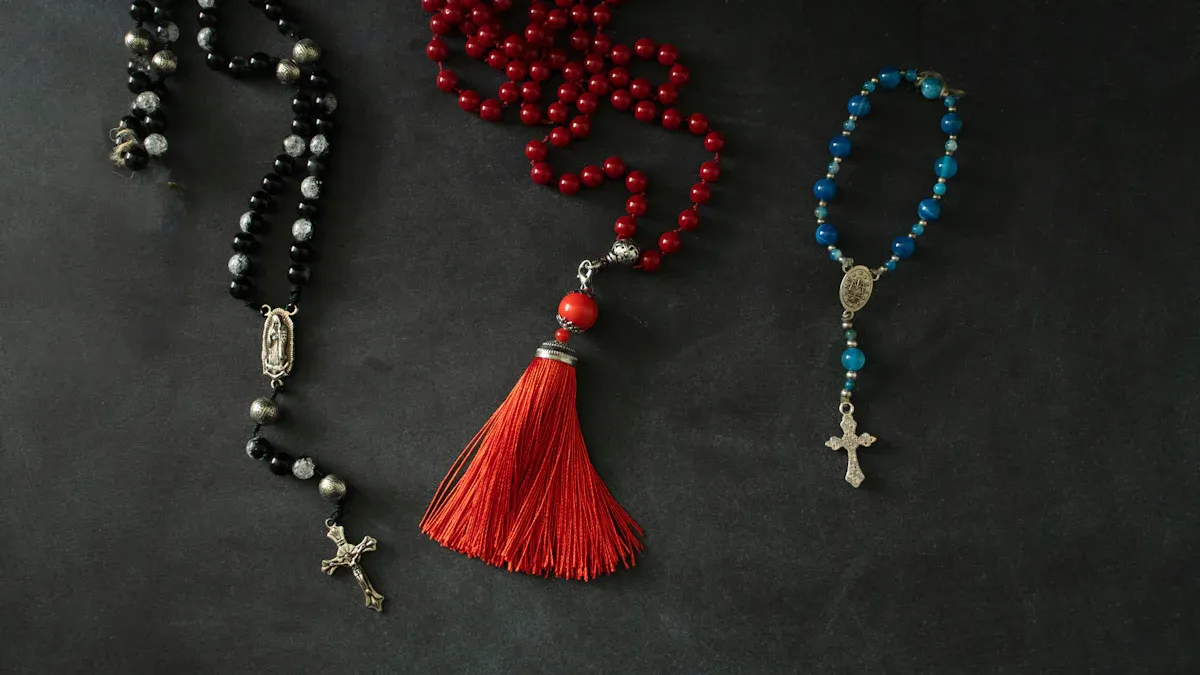
Mala Beads: Background and Use
You might wonder why so many people use mala beads for meditation. Malas have a long history that goes back over 3,000 years in India. The Vedas, which are ancient Hindu texts, mention malas as tools for japa, or repeating mantras. When you use a mala, you can focus your mind and keep track of your mantra recitations. This helps you stay calm and centered during your spiritual practice.
A mala usually has 108 beads. This number is special in Hinduism. It stands for spiritual ideas and helps you complete a full round of mantra recitation. You start at the bead next to the guru bead, which is larger than the others. You hold the mala in your right hand and use your thumb to move from bead to bead. The guru bead marks the end of the round, and you do not cross over it. Instead, you turn the mala around and go back the other way.
Here’s a simple way to use a mala for meditation:
Think about your purpose for meditating.
Hold the mala and find the bead next to the guru bead.
Focus on your intention.
Say your mantra on the first bead.
Move to the next bead and repeat your mantra.
Continue until you reach the guru bead.
Pause and feel grateful.
You can also use malas to count breaths. Some people breathe in and out for each bead, finishing at the guru bead.
Rosary: Christian Practice
The rosary is a special set of prayer beads used by many Christians. Its roots go back to early Christian monks who counted prayers with beads. Over time, the rosary became a structured way to pray, especially after St. Dominic encouraged its use in the 13th century. The rosary has changed over the years, with new prayers and mysteries added, like the Luminous mysteries by Pope John Paul II.
When you use a rosary, you follow a set pattern of prayers. You start with the crucifix and say the "In the Name of the Father" prayer. Then you move through the beads, saying prayers like the "Hail Mary" and "Glory Be." Each bead helps you keep track of your prayers and stay focused. The rosary connects you to a long tradition of faith and reflection.
Design and Materials of Prayer Beads
Common Materials
When you pick up prayer beads, you might notice how different they feel in your hands. The materials can change the whole experience. Some feel smooth and cool, while others feel warm or textured. People across Taoist, Hindu, and Christian traditions often choose materials that hold special meaning or energy.
Here are some of the most common materials used for prayer beads:
Wood
Stone
Gems
Seeds
Bone
Precious metals
Synthetic materials like plastic or glass
Natural fibers such as cotton, silk, or animal hair
You can see how each tradition uses these materials in its own way. For example, Taoist and Hindu prayer beads often use wood, seeds, or gems. Christian rosaries might include wood or metal. The material you choose can add a deeper layer to your practice. Wood gives a sense of grounding and nature. Seeds remind you of growth and new beginnings. Gemstones bring their own energy, like calm or protection.
Tradition |
Common Materials Used |
|---|---|
Taoist |
Wood, stone, gems, seeds, bone, precious metals |
Hindu |
Wood, stone, gems, seeds, bone, precious metals |
Christian |
Various materials, often including wood and metal |
Bead Arrangement
The way prayer beads are arranged can tell you a lot about their purpose. In Hinduism, you usually see 108 beads on a japa mala. This number is sacred and helps you keep track of mantras. You start at the guru bead and move through each bead as you chant. In Christianity, the rosary has 59 beads. Each bead guides you through a set of prayers, like the "Our Father" and "Hail Mary." Taoist prayer beads can have different numbers, sometimes matching the days in a year or a special ritual.
Religion |
Name of Prayer Beads |
Number of Beads |
Purpose/Use |
|---|---|---|---|
Hinduism |
Japa Mala |
108 |
Used for counting while chanting or reciting mantras, and for meditation. |
Buddhism |
Mala |
108 |
Used to count mantras or prayers. |
Islam |
Masbaha |
99 or 33 |
Used for reciting names of Allah and specific prayers. |
Christianity |
Rosary |
59 |
Used to guide prayers and help focus during prayer. |
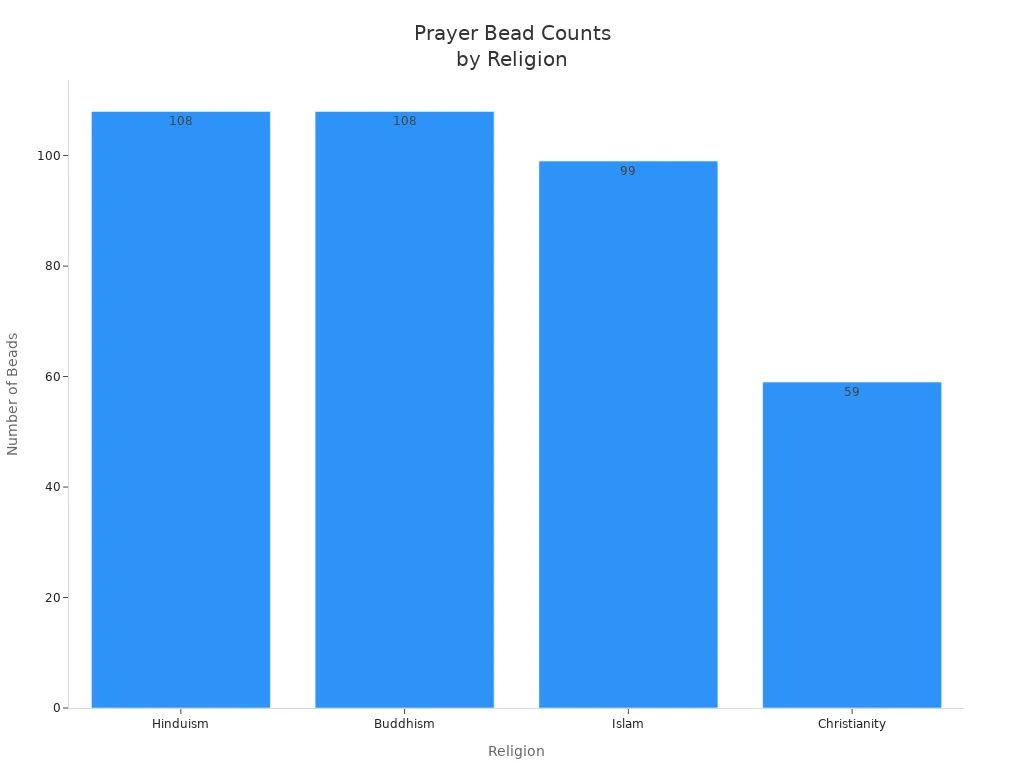
You might find that the arrangement of beads helps you stay focused and gives rhythm to your spiritual practice. Each tradition has its own way of guiding you through prayer or meditation.
Using Prayer Beads in Spiritual Practice
Taoist Rituals and Daily Use
You might notice that Taoist prayer beads show up in many parts of daily life. These beads are not just for big ceremonies. You can use them in small, personal ways every day. When you visit a Taoist temple, you may see priests placing amulets on altars or burning them to send prayers to the heavens. Sometimes, people drink water mixed with ashes from burned amulets for healing or blessings. This practice connects you to ancient traditions.
At home, you might touch your amulet or prayer beads before leaving the house. Many people say a short prayer while holding the beads. This simple act can help you feel safe and focused. During festivals, families paste talismans on doors to invite good luck and keep away bad spirits. Taoist prayer beads often blend into your daily routine, becoming part of your habits and even your style. You might wear them as a bracelet or necklace, letting them remind you to stay calm and mindful.
Mala Meditation Techniques
Mala meditation gives you a clear way to focus your mind. The word mala means "garland" or "string of flowers." You use a mala to count the recitation of prayers or incantations. This helps you pay attention to your meditation instead of counting in your head. Most malas have 108 beads, but you can also find ones with 18, 27, or 54 beads. The number 108 beads is very important in Hindu tradition.
Here is how you can practice mala meditation:
Sit in a quiet place and hold your mala in your right hand.
Start at the bead next to the guru bead.
Say your chosen mantra or prayer for each bead.
Move to the next bead with your thumb after each repetition.
Continue until you reach the guru bead again.
Do not cross over the guru bead. If you want to keep going, turn the mala around and repeat the process.
Mala meditation helps you stay present. You can use it to repeat a mantra, count your breaths, or focus on a positive thought. The 108 beads give you a full cycle for your practice. Many teachers say that using a mala makes meditation easier and more enjoyable. You might find that the rhythm of moving from bead to bead helps you relax and clear your mind. Some people use malas made from special materials, like rudraksha seeds or sandalwood, to add meaning to their practice. The 108 beads also connect you to a long tradition of spiritual seekers.
Rosary Prayers
The Christian rosary gives you a structured way to pray and reflect. When you use a rosary, you begin with the sign of the cross. You then recite the Apostles' Creed, followed by the Our Father. Next, you say ten Hail Marys while thinking about a special event, called a mystery, from the lives of Jesus and Mary. Each decade, or group of ten beads, focuses on a different mystery. After each decade, you say the Glory Be and the Fatima prayer.
The rosary has 59 beads and a cross. Each bead guides you through a set of prayers. The mysteries come in three sets: Joyful, Sorrowful, and Glorious. These mysteries help you meditate on important moments in Christian faith. The rosary leads you to a deeper relationship with the divine and helps you feel connected to a long tradition of prayer.
Here is a table that shows the main forms of prayer in the rosary:
Form of Prayer |
Description |
|---|---|
Joyful Mysteries |
Focuses on the incarnation of God in Jesus, including events like The Annunciation and The Nativity. |
Sorrowful Mysteries |
Centers on the passion of Jesus, highlighting events such as The Crucifixion and Jesus' Agony. |
Glorious Mysteries |
Celebrates the resurrection and ascension of Jesus, including The Resurrection and The Ascension. |
Individual Prayers |
Each bead represents a prayer (Our Father, Hail Mary, Glory Be) recited in sequence. |
Structure of the Rosary |
Typically includes 59 beads and a cross, guiding the prayer through significant stages of Jesus and Mary’s lives. |
You can see that the rosary has a clear order. This structure helps you stay focused and gives meaning to each prayer. The rosary is different from mala meditation and Taoist prayer beads. It uses a set pattern and connects you to the stories of faith.
Comparing Methods and Meanings
You might wonder how these practices differ. Taoist prayer beads often blend into your daily life and even your style. You can use them for quick prayers, protection, or as a reminder to stay mindful. Mala meditation focuses on repetition and the sacred number 108 beads. You use malas to count mantras or breaths, helping you go deeper into meditation. The rosary gives you a set order of prayers and mysteries. Each bead leads you through a journey of faith and reflection.
Here is a quick comparison:
Religion |
Type of Prayer Beads |
Main Use |
Unique Features |
|---|---|---|---|
Taoism |
Prayer Beads |
Daily rituals, protection, focus |
Flexible bead counts, often worn or carried |
Hinduism |
Mala |
Meditation, mantra repetition |
108 beads, guru bead, used for mala meditation |
Christianity |
Rosary |
Structured prayer, contemplation |
59 beads, decades, mysteries, clergy blessing |
You can choose the practice that fits your needs. Some people like the freedom of Taoist prayer beads. Others enjoy the rhythm of mala meditation with 108 beads. Many find comfort in the structure of the rosary. Each tradition offers a unique way to connect with your spiritual side.
Symbolism and Spiritual Benefits
Taoist Meanings
When you use Taoist prayer beads, you hold more than a meditation tool. Each bead can help you think about nature’s flow and the balance of yin and yang. Taoist beads often remind you of the seasons or the days in a year. Some sets have 365 beads, just like the number of days in a year. This helps you remember to live in balance with the world.
Taoist beads are made from special things. Bodhi seeds mean wisdom. Lotus seeds stand for purity. Stones like tiger’s eye or black onyx are for protection. Using these beads can bring these good qualities into your life. Many people feel calm and focused when they touch the beads. You can use them for short prayers, to set goals, or to remind yourself to breathe.
Mala and Rosary Symbolism
Mala beads and rosaries each have their own special meanings. When you use a mala, you follow a tradition that honors life’s cycle and the search for wisdom. The table below shows what each part of a mala stands for:
Element |
Symbolism and Interpretation |
|---|---|
Counting Beads |
The main strand has 108 beads, showing spiritual meaning and a link to the universe. |
Guru Bead |
Stands for the bond between teacher and student, and marks the start and end of meditation. |
Tassel |
Shows a connection to the divine and the person’s spiritual path. |
Circular Shape |
Stands for life’s cycle and the never-ending flow of life. |
Sacred Number 108 |
Has deep meaning in Hinduism and Buddhism, and is tied to spiritual ideas and enlightenment. |
Rosaries use symbols to help you pray. The cross stands for faith and hope. Each bead helps you think about a special moment or mystery. Both malas and rosaries help you find peace and connect with something bigger.
You might wonder what good things can come from using these beads. Here are some common spiritual benefits:
Spiritual Benefit |
Description |
|---|---|
Focus on Inner Self |
Mala beads help people focus on their true self during meditation. |
Mental Grounding |
They help you feel steady and raise your spiritual awareness. |
Stress Reduction |
Using mala beads in meditation can lower stress and help your feelings. |
You can see that these beads do more than count prayers. They help you feel calm, focused, and connected. If you want to learn more about how these tools are used in daily life, check out our section on "Using Prayer Beads in Spiritual Practice" above.
Choosing Your Prayer Beads
Factors to Consider
Picking the right prayer beads can feel special. You want something that fits your style and supports your spiritual journey. Before you choose, think about what matters most to you. Here are some things you might want to keep in mind:
Factor |
Description |
|---|---|
Intention of Use |
Decide if you want your mala for meditation, prayer, or as a meaningful accessory. |
Material Preference |
Pick materials that feel good to you. Some people like gemstones, wood, or seeds for their energy. |
Symbolic Significance |
Look for symbols that mean something to you or match your spiritual path. |
Aesthetic Appeal |
Choose a design that you find beautiful, whether it is simple or fancy. |
You might notice that malas come in many styles. Some have bright colors, while others look simple. If you want a mala for meditation, you may want to pick one with 108 beads. This number is important in Hindu and Buddhist traditions. If you feel drawn to Christian rosaries, you might like the way the beads guide you through prayer. Taoist prayer beads can be flexible, so you can find a set that matches your daily routine.
Personal Reflection
Your beliefs and goals play a big part in your choice. Ask yourself what you hope to gain from using prayer beads. Do you want to focus during meditation, or do you want to follow a set prayer? Maybe you like the feel of malas made from seeds or gemstones. Some people enjoy the structure of a rosary, while others prefer the freedom of Taoist beads.
Here is a quick look at how different types of beads might fit your needs:
Type of Prayer Beads |
Key Features |
Spiritual Significance |
|---|---|---|
Hindu Mala |
108 beads, often made from seeds, wood, or gemstones |
Used for counting mantras during meditation, with the number 108 holding spiritual meaning |
Christian Rosary |
54 smaller beads and 5 larger ones, includes a crucifix |
Used for specific prayers, guiding through the prayers and mysteries of the rosary |
Buddhist Mala |
Knotted beads for counting mantras |
Helps in focusing during meditation and prayer |
Islamic Misbaha |
Often made from wool or silk |
Used to count Quran recitations, aiding in spiritual reflection |
Tip: Take a moment to hold different malas or prayer beads in your hand. Notice how each one feels. Sometimes, the right choice just feels right.
You’ve seen how Taoist prayer beads, Hindu malas, and Christian rosaries each have their own story and purpose. All help you focus and find peace, but their designs and meanings set them apart. Think about which type matches your spiritual goals or daily habits. You might discover a new way to connect with yourself. Feel free to share your experiences and explore these traditions with respect and curiosity.
Pieces That Carry This Intention
Beads meant to be handled while you practice, not just worn.


FAQ
What makes Taoist prayer beads different from malas and rosaries?
You will notice Taoist beads often have flexible bead counts. Malas usually have 108 beads. Rosaries have a set pattern with 59 beads. Taoist beads can blend into daily life, while malas and rosaries follow more structured rituals.
Can I use prayer beads if I am not religious?
Absolutely! You can use prayer beads for meditation, stress relief, or focus. Many people enjoy the calming feeling, even if they do not follow a specific faith. It is all about what helps you feel centered.
How do I choose the right type of prayer beads?
Think about your goals. Do you want to meditate, pray, or just feel calm? Try holding different beads. Notice which ones feel right. For more on Taoist ideas, explore The Core Principles of Taoism.
Do the materials of prayer beads matter?
Yes! Some people pick wood, seeds, or gemstones for their energy or meaning. You might like the feel of smooth wood or cool stone. Choose what feels good in your hand and matches your intention.
Can I wear prayer beads as jewelry?
You sure can! Many people wear prayer beads as bracelets or necklaces. They look nice and remind you to stay mindful. Just remember to treat them with respect, especially if they have spiritual meaning.
See Also
Prayer Beads vs. Mala Beads: Differences and Similarities
Taoist Prayer Beads Explained for Beginners