
Taoism Gods & Immortals: The Taoist Pantheon Explained

The Taoist pantheon has important gods like the Jade Emperor. It also has the Three Pure Ones and the Eight Immortals. These deities and xian help shape the spiritual world in Taoism. Taoist gods and immortal beings guide people in worship and ritual. They also help people try to become immortal. The idea of immortality makes followers want to learn from these deities.
Taoist deities and immortals are very important in Taoist religious practice. They are part of rituals and stories about holy people. They also help make up the Taoist pantheon. Taoism and popular religion show how these deities help with spiritual needs.
Learning about these gods and xian shows how worship affects daily life. It also shows how the pantheon helps people grow spiritually.
Key Takeaways
The Taoist pantheon has important gods and immortals. Some examples are the Jade Emperor and the Eight Immortals. They guide people in worship. They also help people grow spiritually.
Taoist deities are set up in a hierarchy. This is like how a government is organized. This system keeps balance in the universe. It also shows what each deity does.
The Eight Immortals, called Ba Xian, show that anyone can become immortal. You can do this by doing good things and practicing spiritually. Their stories teach people to be wise and kind.
Worship in Taoism uses rituals and offerings. People also show respect for the gods. These actions help people feel close to the divine. They also bring peace and balance to life.
Taoism and Manifest gives resources like temple-certified products. These help people grow spiritually. These tools help people honor the deities. They also help people find harmony every day.
Taoist Pantheon Structure
Hierarchy of Deities
The Taoist pantheon is organized like a government. The Three Pure Ones and the Four Sovereigns are at the top. Under them are other important deities. The Great Emperor of Longevity and the Golden Mother Yuanjun are some of these. The Jade Emperor is a leader who watches over many gods and spirits. This system has been around for a long time. It helps keep balance in the universe.
Taoist scholars have explained the ranks of deities. Jin Yunzhong listed 360 deities in eleven ranks. The table below shows these ranks in the Taoist pantheon:
Rank |
Description |
|---|---|
1 |
Highest beings in the Taoist genealogy. |
2 |
Great Emperor of Longevity, Celestial Sovereigns, Eastern Duke, Western Queen Mother. |
3 |
Ten Great Yuis, Sun, Moon, Five Planets, Big Dipper, 28 Constellation Stars. |
4 |
Five Emperors, Three Officials, Four Saints. |
5 |
Famous masters who taught scriptures. |
6 |
Demon Kings, Spirit Kings, Immortal Officials. |
7 |
Gods of the Five Great Mountains, Fengdu Underworld. |
8 |
Great Emperor of Fusang, gods of Water Palaces. |
9 |
Masters and gods of different departments. |
10 |
Merit officials, messengers, and helpers. |
11 |
Lower-level deities like City God and Earth God. |
Categories: Gods vs. Xian
Taoist deities are split into two main groups. These are gods and xian. Gods have special jobs. They look after health, nature, and cities. Many gods work like officials. Each one has a duty. For example, the City God keeps a city safe.
Xian are immortals. They were once humans. They became immortal through Taoist practice. Each xian has a special power or symbol. Some have a fan or a flute. They show what happens when someone follows Taoism and seeks harmony with the Tao.
Taoism also sorts immortals in different ways. Some are Celestial Immortals. They work in the Heavenly Court. Others are Earthly Immortals. They live with people. These groups help people learn about the pantheon.
Taoism and Manifest helps people connect with these deities and xian. The brand gives temple-certified products and learning tools. These things help people grow spiritually. They also help people get guidance from the Taoist pantheon.
The Three Pure Ones & Supreme Deities
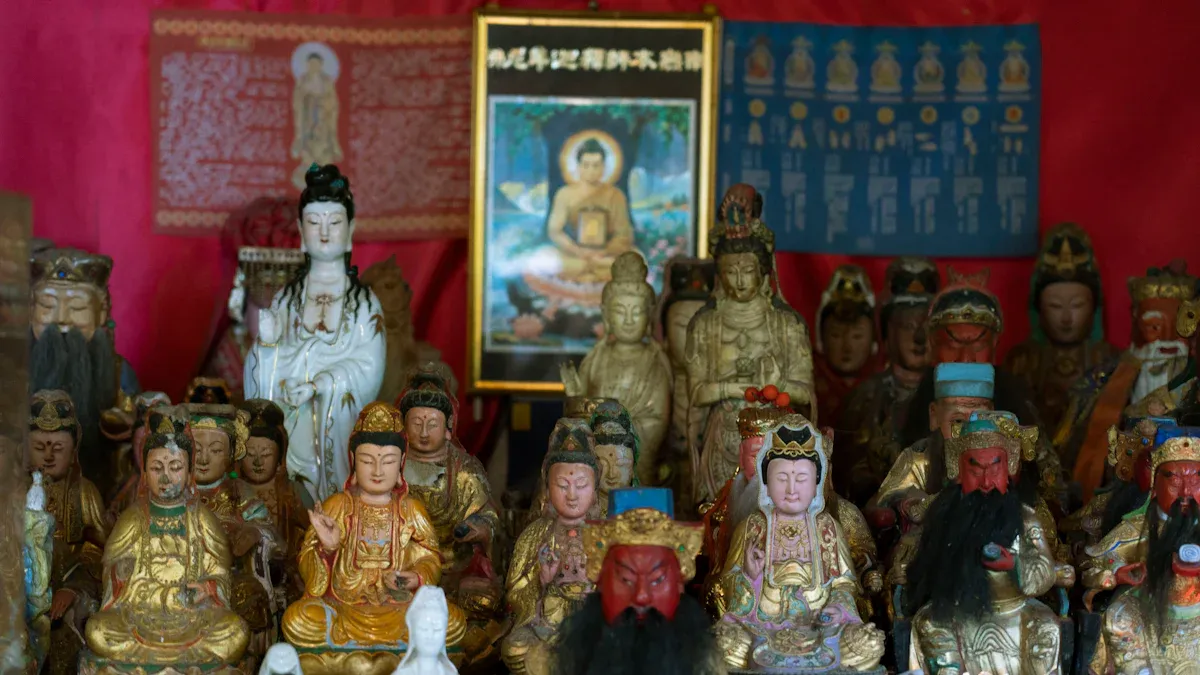
The Three Pure Ones, called Sanqing (Three Pure Ones), are at the top of the Taoist pantheon. They show the purest part of the Tao and where all living things come from. Each Pure One links to a part of the body and spirit: jing means essence, Qi means energy, and shen means spirit. These deities guide the universe and give wisdom to people who want harmony with the Tao.
The Three Pure Ones make up the Taoist Trinity.
They show the pure form of the Tao.
Each one has a special job in creation and spiritual help.
(To explore more about harmony in life, check out Living in Harmony with Taoism: Finding Balance and Energy Flow in Daily Life.)
Yuanshi Tianzun (Primordial)
Yuanshi Tianzun is the Celestial Venerable of the Primordial Beginning. He is the highest of the Three Pure Ones. He is the source of truth and made the universe. Taoist tradition says he is the Great Tao in human form. He watches over the first stage of creation and brings everything into being.
Yuanshi Tianzun begins the universe’s creation.
He becomes Lingbao Tianzun, who splits Yin and Yang.
The last step is Daode Tianzun, who teaches the Law.
People respect Yuanshi Tianzun for his powers. He controls immortality, creation, and the elements. He is the base of Taoist cosmology.
Lingbao Tianzun (Numinous Treasure)
Lingbao Tianzun stands for change and cosmic order. Taoist texts say he is a form of the Great Tao. He keeps the universe balanced and helps with rituals, especially those for souls. Stories say he was born in the Western Green Jade Kingdom after a long wait. He became wise and got the Lingbao Mahayana teachings from Yuanshi Tianzun. Lingbao Tianzun splits Yin and Yang and brings knowledge to people.
Lingbao Tianzun’s lessons are about change and saving souls.
Daode Tianzun (Way and Virtue)
Daode Tianzun is also called the Grand Pure One. He is linked to Lao Tzu, who wrote the Tao Te Ching. He spreads Taoist wisdom to people. Daode Tianzun stands for the Tao and its virtues. He guides people with wisdom and enlightenment. He shows how Yin and Yang work together, which causes endless change and growth.
Daode Tianzun’s place in the pantheon reminds people to find balance, accept change, and follow the path of virtue.
Jade Emperor & Celestial Gods
Jade Emperor’s Role
The Jade Emperor is the top ruler in the Taoist pantheon. People think he keeps everything in order in heaven and on earth. He is the highest god among all the gods and immortals. Many temples are built for him. His picture is in homes and shrines all over China. The Jade Emperor is important in daily life. He shapes traditions and makes people show respect.
Here is a table that explains his main jobs and how people honor him:
Aspect |
Description |
|---|---|
Role |
Supreme ruler of heaven, overseeing the cosmic order. |
Veneration Practices |
Celebrated through rituals, especially during his annual birthday festival with incense, prayers, and performances. |
Influence |
A pan-Chinese figure impacting daily folk practices and inspiring geographical names across China. |
People celebrate the Jade Emperor’s birthday with incense, prayers, and shows. These rituals honor him and ask for good luck. He is in many folk stories and place names. This shows how much he matters in Chinese culture.
Celestial Bureaucracy
The celestial bureaucracy in Taoism is like a government. The Jade Emperor is the leader of this system. He gives orders to gods, goddesses, and immortals. Each one has a job, like ministers and officials in a royal court.
The Jade Emperor rules the universe and keeps things balanced.
Gods and immortals work as officials, each with a job.
Tianguan, or Heavenly Officials, take care of weather, farming, and justice.
This system helps people see how the spirit world works. Every god or immortal has a clear job. People pray to different officials for help with health, weather, or fairness. The celestial bureaucracy shows how order and harmony are important in the Taoist universe.
Major Taoist Gods and Xian
Queen Mother of the West
The Queen Mother of the West is a very important deity in the Taoist pantheon. She is found in old Chinese books and has a long history in Taoism. People also call her Yaochi Jinmu, or the Golden Mother of the Shining Lake. She rules the western paradise. She is linked to immortality, good fortune, and long life. Her stories show her power and how she gives blessings to gods and xian.
Characteristic/Myth |
Description |
|---|---|
Origins |
The Queen Mother of the West is found in oracle bone writings from the Shang dynasty (1766 – 1122 BCE), which shows she is very old. |
Early Depictions |
At first, she was shown as a fierce goddess of death with tiger teeth. She ruled wild animals and sent sickness. |
Taoist Integration |
When she became part of Taoism, she was linked to immortality, good fortune, and long life. |
Blessings |
People believe she gave the Eight Immortals special powers. |
Titles |
She is called Yaochi Jinmu (Golden Mother of the Shining Lake) and other names that show her high rank. |
Cultural Influence |
She became more popular in the second century BCE, especially when the Silk Routes opened. |
The Queen Mother of the West is in many stories about the ba xian. She gives them peaches that make them live forever and teaches them about balance in the universe. Many Taoist ceremonies honor her. People pray to her for health and a long life. She also helps people who want to grow spiritually and become wise.
Earth God (Tudigong)
The Earth God, or Tudigong, is very important in Taoist worship and stories. People see him as the guardian of land, towns, and farming. He watches over the fields and helps farmers grow crops. Each town or village might have its own Tudigong. This shows he is close to the people. People ask him for help when there is not enough rain or food.
Tudigong has been important since ancient times when farming was how people lived. Long ago, landowners gave gifts to a pile of earth to show respect for the land. Later, Tudigong became a main figure in Taoist worship. He controls how well people do and helps keep their lives safe. In the countryside, families honor him as the guardian of graves. They pray and give gifts before burials, hoping he will protect their ancestors. This shows how Tudigong is a big part of daily life for Taoist followers.
Other Key Deities
The Taoist pantheon has many other gods and xian who help keep the universe in order. Each one has a special job and brings different blessings to people who follow Taoism. Here are some of the most important deities:
The God of Wealth (Caishen): He brings money and success. People pray to him during the New Year and ask for good luck in business.
The God of Literature (Wenchang Dijun): He helps students and scholars. Many pray to him before tests or when they want to be wise.
The God of War (Guan Yu): He stands for loyalty and fairness. He protects people from danger and helps them make good choices.
The Kitchen God (Zao Jun): He watches over the home and tells the jade emperor about the family’s actions. Families give him gifts before the New Year.
The City God (Chenghuang): He guards cities and towns. People ask him for safety and peace in their homes.
The Dragon Kings: They control rain and water. Farmers and fishermen pray to them for good weather and safe trips.
The Star Lords (Fuxing, Luxing, Shouxing): They stand for happiness, wealth, and long life. People put their pictures in homes to bring blessings. In feng shui they are better known as Fuk, Luk, and Sau; see Fuk Luk Sau: Symbols of Prosperity and Longevity in Feng Shui.
Many of these gods work with the jade emperor and the ba xian. They help keep balance in the universe and support people’s spiritual growth. The ba xian, or Eight Immortals, are in many stories with these gods. Each immortal shows a different way to become xian through their own hard work and adventures. The ba xian inspire people to live in harmony with the Tao and to be good every day.
Taoist worship uses ceremonies, prayers, and gifts for these gods and xian. People think honoring the deities brings safety, health, and spiritual growth. The ba xian show that normal people can become xian if they work hard and practice. Their stories help followers trust the wisdom of the Taoist pantheon and look for advice from the gods.
Note: The Taoist pantheon shows the values of Taoism. It teaches people to respect nature, keep balance, and try to live forever. By learning about these gods, people can find ideas for their own spiritual path.
Eight Immortals (Ba Xian)
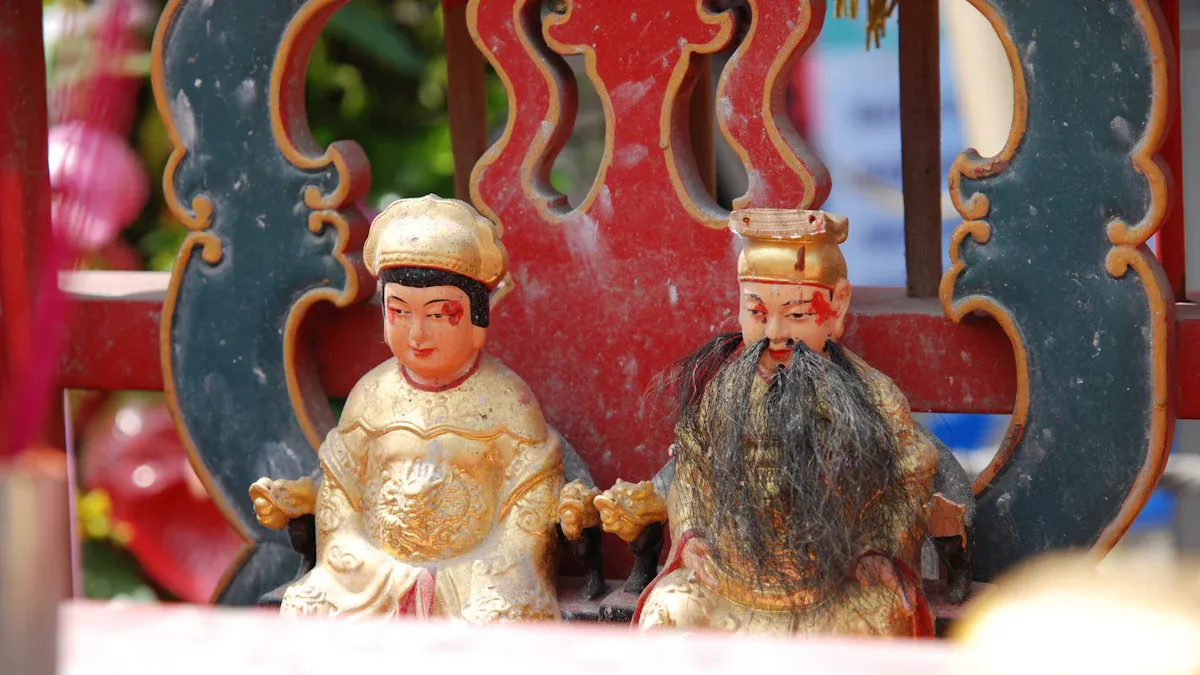
The Eight Immortals are called Ba Xian. They are famous figures in the Taoist pantheon. Each one has a special story and power. They became xian by working hard and being good. Their adventures help people want to grow spiritually. The ba xian are in many stories, art, and rituals. They show that anyone can become immortal by following the right way. (For the full story and symbols of each immortal, see Eight Immortals in Taoism: Names, Stories & Symbolism.)
The ba xian stand for wealth, long life, and spiritual growth. Their pictures and stories are loved in Chinese culture. You can find them in old paintings and new movies and games.
Zhongli Quan
Zhongli Quan is the leader of the ba xian. He is shown with a fan that brings people back to life. His journey started after losing a battle. He learned from five Taoist saints. He found a jade box with secrets to immortality. A celestial crane helped him go to the heavens. Zhongli Quan did miracles, like drying a grave quickly. He tested his wife’s loyalty by changing his shape. He learned alchemy and could turn metals into gold and silver. His fan shows his power and can even bring back the dead.
Unique Power: Magic fan that calls gods and revives life.
Symbolism: Alchemy and spiritual change.
Role: Guides others to immortality and wisdom.
Lü Dongbin
Lü Dongbin is a well-known ba xian. He has a sword that drives away evil and a fly-whisk. His stories are about spiritual change and learning. He helps others become immortal. In many stories, he teaches willow spirits the way of the Tao. Lü Dongbin’s sword cuts through lies and protects good people.
Unique Power: Sword that fights evil.
Symbolism: Spiritual help and learning.
Zhang Guolao
Zhang Guolao is known for his strange powers. He rides a white donkey that he can fold and carry. He can make himself invisible. He drinks water from poisonous flowers and is not hurt. Zhang Guolao once died at a temple gate but came back alive on a far mountain. His stories show the fun and mystery of the ba xian.
Unique Power: Drum that calls for help and fast travel.
Symbolism: Being different and controlling life and death.
Role: Brings fun and wonder to the Taoist pantheon.
Cao Guojiu
Cao Guojiu was born into a noble family. He was Empress Cao’s younger brother. He tried to fix his brother’s mistakes. He left his job to learn Taoist arts. Zhongli Quan and Lü Dongbin taught him how to grow spiritually. Cao Guojiu’s story is about duty, honesty, and searching for truth. He wears official robes and holds a jade tablet.
Unique Power: Tablet that talks to the heavens.
Symbolism: Good character and being fair.
Role: Shows virtue and justice in the ba xian.
Li Tieguai
Li Tieguai is called Iron-Crutch Li. He looks like a beggar with a crutch and a gourd. His story tells how he lost his good looks and got a new body. Li Tieguai helps poor people and heals the sick. His iron crutch means strength and not giving up. The gourd he carries holds spiritual power and medicine.
Unique Power: Gourd that keeps and refines essence.
Symbolism: Kindness, strength, and helping common people.
Role: Healer and helper in the eight immortals.
Han Xiangzi
Han Xiangzi is the patron of musicians. He plays a flute that can show feelings and change energies. His music brings peace and change. Han Xiangzi is famous for making “Heavenly Flower Echo,” a song for peace. In Chinese opera, his music shows the power of Taoist alchemy.
Unique Power: Flute that lifts and changes spirit.
Symbolism: Learning, music, and spiritual growth.
Role: Brings joy and harmony in the ba xian.
Lan Caihe
Lan Caihe is special for their unclear gender. This immortal wears both men’s and women’s clothes. Lan Caihe’s story teaches that spiritual freedom is above rules. They carry a basket of flowers that brings wealth and luck. Lan Caihe’s life shows that anyone can become immortal.
Unique Power: Basket that brings wealth and luck.
Symbolism: Being different, harmony, and acceptance.
Role: Messenger of plenty and freedom in the eight immortals.
He Xiangu
He Xiangu is the only woman in the ba xian. She started as a poor girl. An immortal taught her how to become xian in a dream. She cared for her parents and helped beggars. Her kindness made her immortal. He Xiangu is a model of virtue and good behavior. She holds a lotus, which gives power and purity.
Unique Power: Lotus that gives power and purity.
Symbolism: Kindness, purity, and moral strength.
Role: Shows virtue and care in the Taoist pantheon.
He Xiangu is not the only woman who reached immortality through devotion. (Read How Taoism Empowers Women to Transcend Social Boundaries for more stories of female immortals.)
The eight immortals show that anyone can become immortal by working hard, being good, and helping others. Their stories help Taoist followers grow and live longer.
Taoism and Manifest shares the ba xian’s wisdom with learning tools and temple-certified products. These help people connect with the deities and find balance in life. The eight immortals inspire those who want health, balance, and clear spirit.
Worship, Influence & Taoism and Manifest
Rituals and Offerings
Taoist worship is about showing respect to deities and xian. People do many rituals to feel closer to them. These rituals help people find balance and grow spiritually. Taoist priests lead these events. They use chanting, music, and dancing. These things help people connect with the gods and xian.
Some common things people do in Taoist worship are:
Cleaning themselves before going into a temple.
Meditating to relax and think about the deities.
Giving incense, fruit, and flowers as gifts to gods and xian.
Doing the chiao ritual, where families give gifts to local deities for cosmic renewal.
Having special ceremonies at temples like Sik Sik Yuen Wong Tai Sin Temple, which mix old and new traditions.
People honor the emperor, the eight immortals, and other deities during these rituals. Each ritual tries to bring peace to the world. They also help followers on their journey to immortality. Worshiping xian and gods shows that people respect their power and help.
(To learn more about immortality, see Seek Immortality and Enlightenment in Taoism.)
Modern Practice and Brand Support
Today, Taoist worship is still part of daily life. Many people burn incense at home for deities and xian. This simple act helps their shen, or spirit, and brings calm. Taoist followers also put pictures of the emperor, gods, and xian in their homes. They pray for health, luck, and to live forever.
Taoist worship means learning from the stories of xian. People try to act like them and follow their path. They believe anyone can become immortal by working hard and practicing. Taoist worship also respects the emperor and the order he keeps.
Taoism and Manifest helps people with modern worship. They offer temple-certified products. These items are blessed by masters and help people connect with deities and xian. The brand gives learning tools, amulets, and music for meditation. Taoism and Manifest helps followers honor the gods, grow spiritually, and look for immortality every day.
Taoist worship helps people get closer to the gods and xian. It brings balance, peace, and spiritual strength.
The Taoist pantheon has many gods and immortals. They help people with worship and daily life. These gods are important in the pantheon. They show why balance, harmony, and spiritual growth matter. Worshiping these gods brings blessings and good health. It also helps people become wise. People honor the gods with rituals and gifts. Worship lets followers learn Taoism’s teachings.
Pieces That Carry This Intention
A few pieces from the shop that sit close to what this article is about.


FAQ
What is the Taoist pantheon?
The Taoist pantheon is a group of gods and immortals. Each one has a special role. They guide people, protect nature, and help with spiritual growth. People honor them in temples and at home.
What makes the Eight Immortals important?
The Eight Immortals show that anyone can reach immortality. Each one started as a regular person. Their stories teach lessons about kindness, wisdom, and strength.
What do Taoist gods do?
Taoist gods help with many parts of life. Some protect cities. Others bring wealth or health. People pray to them for guidance and blessings.
What is a xian in Taoism?
A xian is an immortal being. They once lived as humans. Through Taoist practice, they gained special powers and eternal life. People look up to them as examples of spiritual success.
What does Taoism and Manifest offer for spiritual growth?
Taoism and Manifest provides temple-certified amulets, learning tools, and meditation music. These resources help people connect with Taoist deities and find peace in daily life.
See Also
Living in Harmony with Taoism: Finding Balance and Energy Flow in Daily Life
Seek Immortality and Enlightenment in Taoism
Eight Immortals in Taoism: Names, Stories & Symbolism
How Taoism Empowers Women to Transcend Social Boundaries
Fuk Luk Sau: Symbols of Prosperity and Longevity in Feng Shui
About This Article
Written by Li Wei. Reviewed by the Taoism & Manifest editorial team.
Sources: This article draws on classical Taoist tradition and the reference sources linked in the text above.
Scope: This article describes Taoist religious tradition, mythology, and historical practice for cultural education. Beliefs and interpretations vary across regions, lineages, and eras.