
Qigong vs Tai Chi: Differences and Which to Start First

Image Source: pexels
Qigong vs Tai Chi: What's the Difference and Which Should You Start?
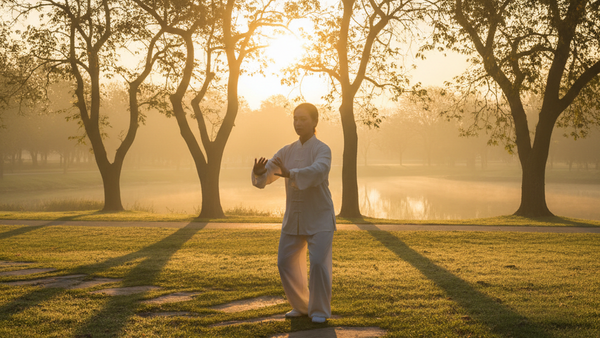
They look the same from across the park. Slow movements. Deep breaths. People who seem weirdly calm at 6 AM.
But Qigong and Tai Chi are different practices. Different origins. Different learning curves. Different strengths.
Here's the honest comparison — no guru talk, just what the science says and what your first month actually looks like with each one.
Key Takeaways
- Tai Chi is a type of Qigong — but Qigong is not a type of Tai Chi. Qigong is the broad category (5,000+ years). Tai Chi is one specific martial art within it (400–900 years old).
- If you want to start today with zero learning curve, pick Qigong. You can learn a basic routine in one session and practice alone within a week. Tai Chi takes months to learn a short form.
- If balance and fall prevention are your main goal, Tai Chi has stronger evidence. A 2023 meta-analysis of 2,850 people found it cuts fall risk by 55%.
- For blood pressure, Qigong has an edge. Across 14 randomized trials, it lowered systolic blood pressure by nearly 9 mmHg — clinically significant without medication.
- Most advanced practitioners do both. The ideal path: start with Qigong for foundation, add Tai Chi when you want structure and progression.
The Core Difference in 30 Seconds

Image Source: pexels
Qigong means "energy work." It's an umbrella term for thousands of practices — standing, sitting, lying down — that cultivate Qi (vital energy) through breath, movement, and intention.
Tai Chi means "Supreme Ultimate Fist." It's a martial art that uses Qigong principles inside a choreographed sequence of combat-derived movements.
Here's the relationship: All Tai Chi contains Qigong. But Qigong includes far more than Tai Chi.
Think of it like this: yoga is a broad category. Ashtanga is one specific style within it. Qigong is yoga in this analogy. Tai Chi is Ashtanga.
Side-by-Side Comparison
| Qigong | Tai Chi | |
|---|---|---|
| Age | 5,000+ years | 400–900 years |
| Origin | Taoist, Buddhist, and medical traditions | Chen village martial arts (Ming Dynasty) |
| Movements | Simple, repetitive, isolated | Choreographed continuous sequence (form) |
| Positions | Standing, sitting, lying down | Standing only |
| Martial element | None | Yes (often de-emphasized in modern practice) |
| Learning curve | Days | Months |
| Daily time | 10–20 minutes | 20–45 minutes |
| Equipment | None | None |
What the Science Says
Both practices have strong clinical evidence. But they show up differently in the data.
Blood Pressure: Qigong Wins
A comprehensive review of 14 randomized controlled trials — 829 participants total — found Qigong lowered systolic blood pressure by 8.9 mmHg and diastolic by 5.0 mmHg (American Journal of Health Promotion, 2010). That's statistically significant. For some people, that's the difference between medication and no medication.
Fall Prevention: Tai Chi Wins
A 2023 meta-analysis of 10 studies and 2,850 older adults found Tai Chi reduced the risk of multiple falls by 55% (Frontiers in Public Health, 2023). The continuous weight-shifting in Tai Chi forms trains dynamic balance in a way that static Qigong postures don't.
Anxiety and Depression: Tie
Both regulate the autonomic nervous system through the same mechanism — slow movement plus coordinated breathing. A 2019 review in Focus found both Qigong and Tai Chi shift the nervous system from sympathetic (fight-or-flight) to parasympathetic (rest-and-digest) dominance.
A separate 2023 meta-analysis of 20 studies and 1,798 participants confirmed Tai Chi significantly outperformed control groups for both anxiety and depression in older adults.
No head-to-head studies have found a meaningful difference between the two for mental health outcomes.
Note: Most clinical studies group Qigong and Tai Chi together as "meditative movement." The reason: the active ingredients — slow motion, breath coordination, and mental focus — are the same. The packaging is different. The mechanism is not.
Sleep: Tai Chi Has an Edge
A meta-analysis in the Journal of Sleep Research (2017) found Tai Chi doubled the sleep quality improvement seen with general exercise. The structured, longer-duration forms may provide a deeper meditative state that carries into nighttime rest.
Your First 30 Days: What to Expect

Image Source: pexels
First 30 Days of Qigong
Week 1: You learn 3–5 standing exercises. Each one is a single movement repeated 8–12 times. You can do the routine independently by day three.
Week 2: The novelty fades. This is where most people quit — because "it feels like I'm not doing anything." That feeling is the practice working. You're learning to feel Qi, not perform Qi.
Week 3–4: You start noticing things outside of practice. Your breathing slows. Your hands feel warm or tingly during the exercises. Stress events that used to spike your heart rate don't hit as hard.
To understand the energy system behind these sensations, see our guide on Qi: its importance for health, balance, and spiritual growth.
First 30 Days of Tai Chi
Week 1: You learn the first 4–6 movements of a short form. You can't remember the sequence without the instructor. This is normal.
Week 2: You're still forgetting the sequence. You're thinking about your feet and losing your arms. Your legs are sore in places you didn't know had muscles.
Week 3–4: You can do the first section (about 8 movements) without looking at the instructor. It doesn't feel smooth yet. But there's a specific moment — usually around week four — where your body does one transition without your brain telling it to. That's the moment you're hooked.
Tip: Most Tai Chi classes start with 10 minutes of Qigong warm-ups. If you show up to a Tai Chi class and realize you love the warm-up more than the form, you're a Qigong person. Follow that signal.
Which One Is Right for You?
Start with Qigong if:
- You're recovering from injury or illness
- You can only commit 10–15 minutes a day
- Memorizing choreography stresses you out
- Your primary goals are blood pressure, energy, or stress reduction
- You want to practice alone at home from day one
Start with Tai Chi if:
- Fall prevention or balance is your top priority
- You enjoy structured learning with clear progression
- The martial arts heritage interests you
- You want a group class and social element
- You have 20–45 minutes daily for practice
Start with both if:
- You want the fastest results. The most common advanced path: Qigong for 3 months first, then add Tai Chi while keeping your Qigong practice as a warm-up.
Five Myths That Confuse Everyone

Image Source: pexels
Myth: "It's just for old people." Elite athletes use Tai Chi for balance training. Tech CEOs use Qigong for stress regulation. The median age of new practitioners in Western studios is dropping into the 30s.
Myth: "You're just waving your arms." Hold a Tai Chi low stance for three minutes. Your quads will disagree with "just waving." Qigong standing meditation (Zhan Zhuang) builds isometric strength that surprises people.
Myth: "It's religious." Rooted in Taoism, yes. Required to be Taoist to practice? No. Modern Qigong and Tai Chi are taught as secular health practices worldwide. The mechanisms are biomechanical and neurological, not supernatural.
Myth: "Qigong is just the warm-up for Tai Chi." Qigong is a complete, independent practice with thousands of styles. Some Qigong systems are more sophisticated than Tai Chi. Treating it as a warm-up is like calling cooking a warm-up for eating.
Myth: "They have the same health benefits." Overlap? Yes. Identical? No. Tai Chi is better for balance and fall prevention. Qigong is better for blood pressure and accessibility. The evidence isn't interchangeable.
To dig deeper into the Tai Chi side, read our article on Tai Chi as a martial art, health practice, and spiritual path.
(If your Qigong or Tai Chi practice involves counting breaths or repetitions, our Taoist prayer bracelets serve as a tactile counter that keeps your mind in the practice, not on the numbers.)
Pieces That Carry This Intention
Beads meant to be handled while you practice, not just worn.


FAQ
Is Qigong easier than Tai Chi?
Yes. Qigong movements are simpler, repetitive, and can be done sitting or lying down. Most people learn a basic routine in one session. Tai Chi requires memorizing a choreographed form — weeks to months depending on style.
Can I do both Qigong and Tai Chi?
Yes, and most experienced practitioners do. Start with Qigong for foundation, add Tai Chi once you want structure and progression. Many Tai Chi classes open with Qigong warm-ups.
Which is better for anxiety — Qigong or Tai Chi?
Both reduce anxiety through the same mechanism — slow movement plus breathwork regulating the autonomic nervous system. If you need something with zero learning curve that you can start today, Qigong has the edge.
Is Tai Chi a type of Qigong?
Yes. Tai Chi is a martial art that uses Qigong principles. But Qigong includes thousands of practices beyond Tai Chi. All Tai Chi is Qigong, but not all Qigong is Tai Chi.
How long does it take to learn Tai Chi vs Qigong?
A basic Qigong routine: one session. Independent practice: one week. A short Tai Chi form (24 movements): 2–3 months. Traditional long form (108 movements): 6–12 months. Mastery of either: a lifetime.