
How Have Prayer Beads Shaped Spiritual Practices Around the World

You might see that prayer beads are special in spiritual life. People in many cultures use them to help with meditation and prayers. They also use them to feel closer to their beliefs. Each bead stands for a time to think and helps you pay attention. The feeling of the beads in your hands can make you feel calm. It can also help you feel like you are in the moment. > Many people think touching the beads gives comfort and makes each prayer or meditation more important.
Key Takeaways
Prayer beads help people pay attention when they pray or meditate. They make people feel calm and help them feel closer to their beliefs.
Many cultures have their own prayer beads. Each kind means something special. Hindu malas have 108 beads. Islamic tasbih usually has 99 beads.
Using prayer beads can help lower stress. They help people focus and remember their beliefs.
Prayer beads are not just for religion. Many people use them to relax and feel less stressed. They are helpful for many reasons.
Each bead stands for a time to think. This helps people grow in their spiritual life and connect with old traditions.
Prayer Beads: Purpose and Meaning
Definition and Origins
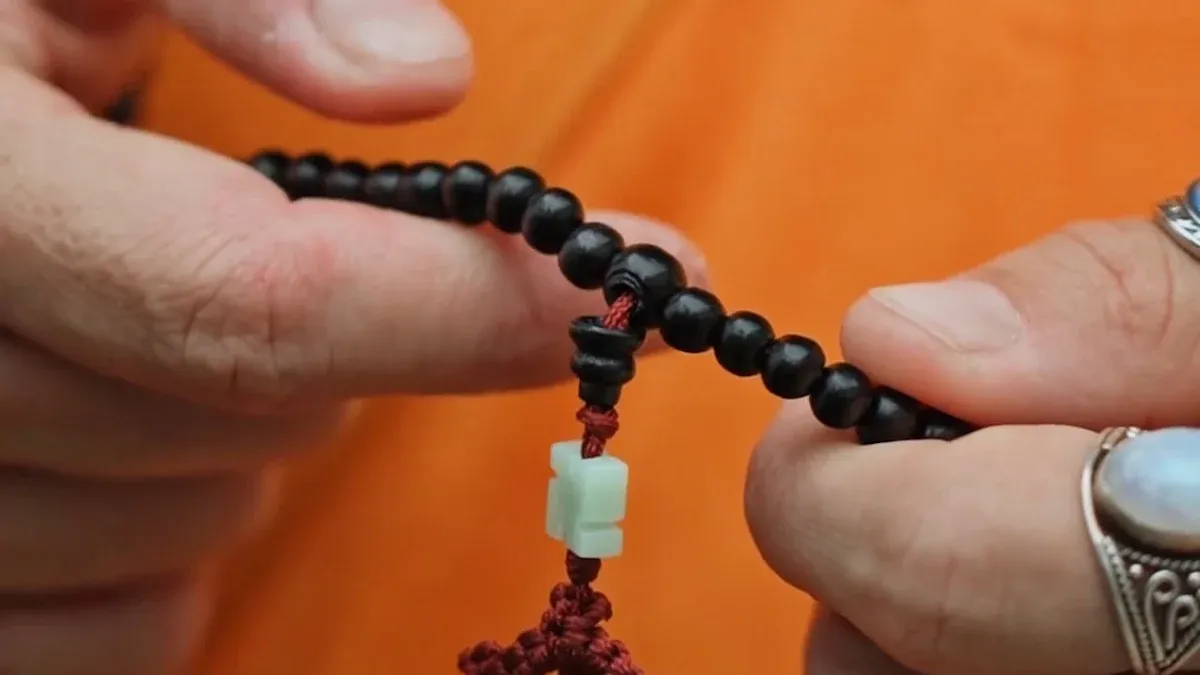
You may wonder where prayer beads come from and why they matter so much. Prayer beads are strings of beads used as a tool for worship in many traditions. People use them to count prayers, chants, or mantras. The earliest known use dates back to the 3rd and 4th centuries, when the Desert Fathers used pebbles to count prayers. Over time, these pebbles became beads on cords. The word "bead" comes from the Anglo-Saxon word "bede," which means "prayer." (To explore this rich history in more detail, check out our article on What is the History Behind Prayer Beads.)
Here is a table showing some early uses of prayer beads:
Time Period |
Evidence of Use |
Description |
|---|---|---|
3rd-4th century |
Desert Fathers |
Used pebbles for counting prayers, which evolved into beads on cords. |
341 AD |
Abbot Paul |
Used three hundred pebbles as counters for prayers. |
659 AD |
Tomb of Gertrude of Nivelles |
Fragments of prayer beads found. |
8th century |
Penitentials |
Prescribed penances with specific numbers of prayers. |
12th century |
Tombs of St. Norbert and St. Rosalia |
Similar devices discovered. |
You can see that prayer beads have a long history. They appear in many cultures and religions. The number and material of beads often hold symbolic meaning. For example, Buddhist and Hindu beads usually have 108 beads, Muslim beads have 99, and Catholic rosaries have 150. These numbers connect to important spiritual ideas in each tradition.
Spiritual Functions
Prayer beads serve as an important spiritual symbol and a tool for worship. When you use prayer beads, you can focus your mind and heart on your spiritual practice. Many people find that the act of moving from bead to bead helps them stay present during meditation or prayer. This simple action can bring a sense of calm and peace.
Using prayer beads allows you to slow down and focus on something peaceful. This can help you feel less anxious and more connected to your spiritual beliefs.
You might notice that prayer beads help you in several ways:
They help you focus your mind.
They make it easier to concentrate during meditation.
They provide a calming and grounding effect.
They enhance your presence and attentiveness during prayer.
Prayer beads also have a cultural and spiritual significance. They link you to ancient traditions and remind you of the symbolic meaning behind each bead. As a tool for worship, they help you keep track of prayers and maintain a steady rhythm. This makes your ritual more meaningful and helps you connect with your spiritual side.
Prayer Beads: Traditions
Prayer beads are used in many religions and cultures. You can find them in Hinduism, Buddhism, Islam, Christianity, and more. Each group has its own kind of prayer beads and ways to use them. These beads help people connect to their beliefs. They also help people focus when they pray or meditate.
Hinduism
Hinduism was the first to use prayer beads. The japa mala is a string of beads for repeating mantras. "Japa" means to repeat quietly or inside your mind. Hindus use japa mala beads to count each time they say a mantra or a god’s name. This helps you stay calm and focused.
Aspect |
Details |
|---|---|
Etymology |
The term japa comes from the Sanskrit root jap-, meaning 'to utter in a low voice, repeat internally, mutter.' |
Spiritual Discipline |
Japa involves the meditative repetition of a mantra or name of God, which can be spoken softly or internally. This practice can occur during meditation, daily activities, or formal worship. |
Use of Japa Mala |
Japa mala beads are typically used to count repetitions of mantras. Commonly, 108 beads are used, with specific materials like Tulsi for Vaishnavas and Rudraksha for Shaivites, each holding significant meaning in their respective traditions. |
Daily Practice |
Many Hindus engage in casual mantra recitation throughout the day, which serves as a means of maintaining a connection to the divine amidst daily life. |
Correct Usage |
The mala is traditionally used with the right hand, avoiding the index finger, which symbolizes ego, to promote a more focused and humble practice. |
A Hindu japa mala usually has 108 beads. This number is special in Hinduism and other religions. The beads can be made from Tulsi wood, Rudraksha seeds, or other things. You move one bead at a time with your thumb and middle finger. This helps you count prayers and stay focused.
Hindu japa malas have 108 beads.
The number 108 is important in Hinduism, Buddhism, and Jainism.
In Buddhism, 108 means 108 afflictions.
It can also mean 108 dharmas or ideas.
In East Asian Buddhism, it stands for 108 meditations or gods.
Buddhism
Buddhism got prayer beads from Hinduism. Mala beads are used in Buddhist meditation and prayer. Each bead stands for a mantra, prayer, or saying. The practice started in Hinduism and spread to Buddhism in places like Tibet and Nepal.
Mala beads are used for meditation and prayer. Each bead stands for a mantra, prayer, or saying.
The use of mala beads began in Hinduism and spread to Buddhism across Asia.
There are usually 108 beads, which is an important number in both religions.
Hindus used malas about 3,500 years ago to count mantras.
When Buddhism started, mala beads became important in Asian cultures like Tibet and Nepal.
The way beads are arranged in Buddhist malas has meaning too.
The number 108 is important in Buddhism and connects you to Dharma.
It stands for parts of life, like the heart chakra and cosmic distances.
In Tibetan Buddhism, it means purifying 108 delusions.
Old Tibetan malas had three big beads to split the 108 beads into four groups of twenty-seven.
The three big beads stand for Buddha, the teachings, and the community.
Two strings of ten small beads are used to count prayers or mantras.
The bead arrangement helps with prayer and meditation.
Dividing beads into groups helps you say mantras in order.
Islam
In Islam, prayer beads are called misbaha or tasbih. Muslims use them to count phrases during dhikr, which means remembering Allah. Tasbih has a long history, going back to the Prophet Muhammad’s time. Early Muslims, like his wife Safiyah, used pebbles to count prayers. Later, these became beads on a string.
Tasbihs have been used since the Prophet’s time. Early Muslims, like Safiyah, used pebbles to count Zikr, starting the practice of Tasbih.
Islamic prayer beads have a long history. The Prophet Muhammad used beads made from dates or pebbles, which later became more detailed.
Using prayer beads in Islam started early and was influenced by older customs. It became part of Islamic worship to help remember Allah.
Muslims often use prayer beads with 33 or 99 beads. Each bead helps count phrases that praise Allah.
Tasbeeh is a type of Dhikr where you repeat phrases to praise Allah, often using beads.
Misbaha usually has 99 beads, matching the Names of Allah, with markers after every 33 beads.
Having 33 or 99 beads helps Muslims say praises many times and focus during prayer.
Christianity
Christians use prayer beads called the rosary. The rosary helps you think about Jesus and Mary’s lives. Early Christians used knotted ropes to count prayers. Over time, the rosary changed into what we see now.
Prayer beads for meditation go back to early Church times and even before Christianity.
In the 12th century, people said 150 Our Fathers instead of 150 Psalms. This was called 'the poor man’s breviary.'
The rosary changed between the 12th and 15th centuries. Fifty Hail Marys were added, linked to stories about Jesus and Mary.
St. Dominic made the rosary popular in the 1200s to help convert people.
The rosary’s modern form, with five groups of ten beads and mysteries, was set by the 1500s. Pope John Paul II added the luminous mysteries in 2002.
The rosary is not the only prayer bead in Christianity. Orthodox Christians use a knotted rope called a chotki for the Jesus Prayer. Anglicans use a rosary with 33 beads in four groups of seven.
Tradition |
Structure Description |
|---|---|
Catholic |
The Dominican Rosary consists of 59 beads, including 50 Hail Mary beads arranged in five decades, with Our Father beads in between. |
Orthodox |
The Jesus Prayer is commonly used, utilizing a knotted rope (chotki) instead of beads, emphasizing traditional practices. |
Protestant (Anglican) |
The Anglican rosary has 33 beads, including an invitatory bead and four groups of seven beads, referred to as weeks. |
You use the rosary to count prayers and think about important Christian events. This helps you feel closer to your faith and focus on devotion.
Other Cultures
Prayer beads are found in many other cultures too. The Maasai people in Africa wear prayer beads as signs of spiritual power. They use them in rituals to connect with gods. Native Americans see beadwork as a spiritual act. Making beadwork honors the spirit world. Some Native Americans add a "Spirit bead" to show only the divine can make something perfect.
Native Americans see beadwork as spiritual. Making beautiful items honors the spirit world.
The 'Spirit bead' shows human work is not perfect. It is added on purpose to avoid bad luck.
Sikhs and Baha’is also use prayer beads. Sikhs use beads like Hindu malas to say God’s names. Baha’is use 95 beads to repeat the Greatest Name of God 95 times each day.
Culture |
Structure |
Use |
Significance |
|---|---|---|---|
Christianity |
59 beads in five decades |
Recitation of prayers, meditation on life of Jesus and Mary |
N/A |
Orthodox |
33, 50, or 100 knots |
Repetition of the Jesus Prayer |
N/A |
Anglican |
33 beads in four groups of seven |
Various prayers and meditations |
N/A |
Hinduism |
108 beads plus one guru bead |
Recitation of mantras, meditation on deities |
108 is a sacred number in Hinduism |
Buddhism |
108 beads |
Counting mantras or breaths during meditation |
N/A |
Sikhism |
Similar to Hindu mala |
Reciting names of God |
N/A |
Baha'i Faith |
95 beads |
Recitation of the Greatest Name of God 95 times daily |
N/A |
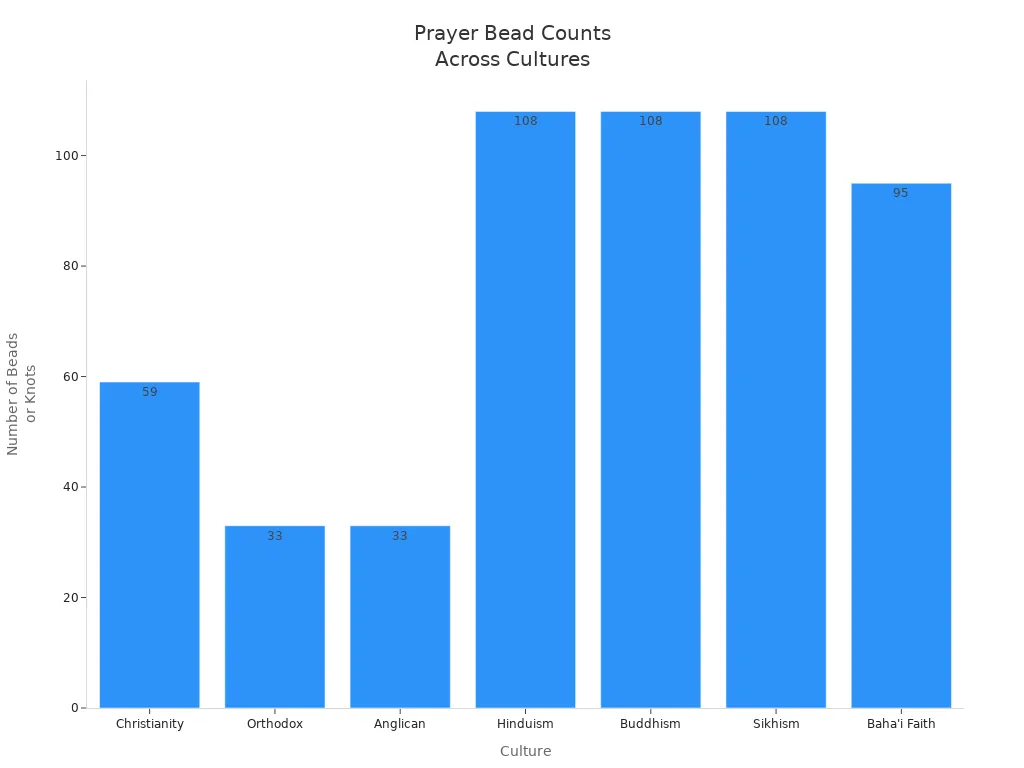
Prayer beads come in many shapes and are used in many ways. They help people focus on prayer, meditation, and devotion. Each religion and culture gives prayer beads its own meaning and style. This shows how important prayer beads are in spiritual life around the world. (For a comprehensive look at these diverse traditions, our guide on Understanding Prayer Beads: Their Historical Roots and Symbolic Meanings is an excellent resource.)
Prayer Beads Across Cultures
Shared Themes
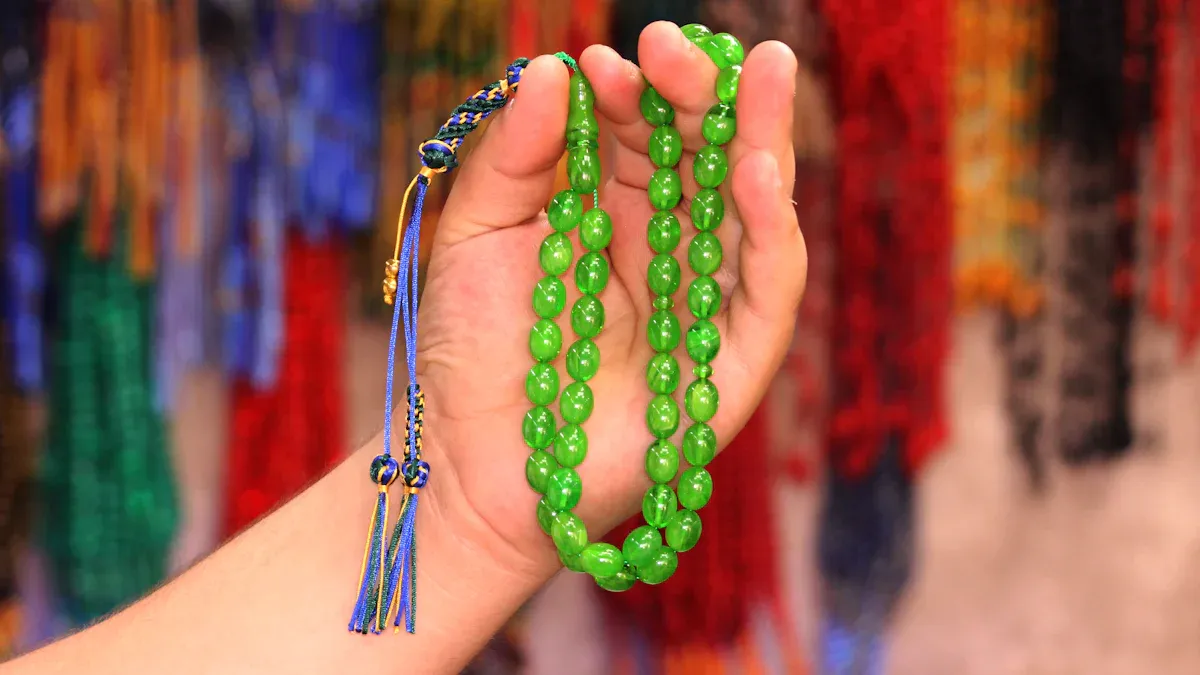
Prayer beads are found in many places. People use them to count prayers and help with meditation. They help you focus and feel calm. Prayer beads connect you to your beliefs and bring peace inside. Using prayer beads brings people together from different backgrounds. In Tibetan Buddhism, prayer beads help count prayers and earn merit. Many cultures think prayer beads give comfort and help you stay aware.
People use prayer beads to count prayers in big religions.
Prayer beads connect different faiths and cultures.
They stand for faith and peace in many places.
In Buddhism, prayer beads help you gain merit.
Many people feel calm and focused when using prayer beads.
Unique Adaptations
Every culture uses prayer beads in its own way. You can see different numbers of beads, materials, and prayers. Some groups say special words or phrases with their beads. The table below shows how each tradition changes prayer beads:
Culture/Religion |
Description of Adaptation |
|---|---|
Islam |
Used to remember God with phrases like 'Subhanallah', 'Alhamdulillah', and 'Allahu Akbar'. |
Christianity |
Known as the rosary, used for prayers dedicated to the Virgin Mary, with 59 beads for 'Ave Maria' and 'Pater Noster'. |
Buddhism |
Mala beads, usually 108 beads, used for meditation and mantra repetition. |
Hinduism |
Mala beads for meditation and repeating mantras. |
Sikhism |
Mala beads for meditation and reciting God’s name, promoting balance and cleansing. |
Prayer beads mean different things in each culture. The meaning changes with the group and the prayers they use.
Modern Practices
Today, prayer beads are used outside of religion too. People use them to relax and lower stress. In Greece and Turkey, prayer beads help people feel calm and may help the mind. Yoga and mindfulness groups use Buddhist malas. Many people wear prayer beads as jewelry. You can pick beads in many colors and shapes to match your style. Some people use prayer beads to help with focus, but it is good to remember their spiritual meaning. Prayer beads can help you feel peaceful, but using them too much might cause problems like OCD. Prayer beads still shape spiritual and daily life in many cultures.
You learn about prayer beads in stories from many cultures. These beads are important and change how people practice their faith. They help you focus, stay calm, and feel less stressed. Prayer beads also remind you of your beliefs every day and bring peace. (If you're new to this practice, our Beginner’s Guide to Using Prayer Beads in 2025 is the perfect place to start.)
You can use prayer beads in easy ways:
Think about your goal before you start.
Touch each bead as you pray or think.
Pick beads made from special materials you like.
You find new stories about prayer beads as you learn more. This journey with prayer beads helps you grow and feel closer to old traditions. (To deepen your practice, explore our guide on How to Use Prayer Beads for Enhanced Meditation Techniques.)
Pieces That Carry This Intention
Beads meant to be handled while you practice, not just worn.


FAQ
What are prayer beads used for?
You use prayer beads to count prayers, mantras, or breaths. They help you focus during meditation or worship. Many people find that prayer beads make it easier to stay calm and connected to their beliefs.
Do all religions use the same number of beads?
No, each religion uses a different number of beads. For example, Hindu and Buddhist malas have 108 beads. Muslim prayer beads often have 33 or 99. Christian rosaries usually have 59 beads.
Can you use prayer beads if you are not religious?
Yes, you can use prayer beads even if you are not religious. Many people use them for relaxation, stress relief, or mindfulness. You can create your own routine that fits your needs.
How do you choose the right prayer beads?
You can choose prayer beads based on material, size, or tradition. Some people pick beads that feel good in their hands. Others look for beads with special meaning or colors they like.
Where can you find an in-depth guide to using prayer beads?
You can find an in-depth guide online, in books, or at spiritual centers. These guides show you how to use prayer beads for meditation, prayer, or relaxation.
See Also
How to Use Prayer Beads for Enhanced Meditation Techniques
Beginner’s Guide to Using Prayer Beads in 2025
Understanding Prayer Beads: Their Historical Roots and Symbolic Meanings