
The Timeless Origins of Prayer Beads in Global Spirituality

A person sits still and moves their fingers on prayer beads. Each bead helps them focus and show devotion. Many cultures made their own prayer beads to help with worship. People use prayer beads to feel close to god, avoid distractions, and stay calm. These beads are very special and are still used in prayers today.
Hindu japa mala beads help people count holy names and feel connected to the universe.
Buddhist mala beads help with meditation and staying mindful.
Islamic misbaha beads help people remember god during dhikr.
Christian rosaries help guide prayers by repeating them in order.
Prayer beads still bring people together from many places and beliefs.
Key Takeaways
Prayer beads help people pay attention during meditation and prayer. They give a way to count prayers or mantras with your hands.
Many cultures have their own prayer beads, like Hindu mala, Buddhist mala, Islamic misbaha, and Christian rosaries. Each kind has its own spiritual use.
The number of beads is often important. For example, Hinduism and Buddhism use 108 beads. Islam uses 33 or 99 beads.
Prayer beads are made from different things. These materials can mean different values. Wood stands for strength. Gemstones are thought to help with healing.
Using prayer beads can help you be more mindful and feel less stressed. They are good for anyone who wants to grow spiritually or feel calm.
History of Prayer Beads
Early Origins
Prayer beads have been used for thousands of years. People in ancient India started using them around 500 BC. Hindu sages used Japa Mala beads to count god’s names while meditating. Sculptures from 185 BC show people holding prayer beads. This means prayer beads were important a long time ago. Japa Mala beads usually have 108 beads. Each bead helps someone keep track of prayers or mantras. Using prayer beads became a daily habit for Hindus. Later, this tradition spread to Buddhism. (To explore this fascinating journey in more detail, read our comprehensive article on What is the History Behind Prayer Beads.)
Many cultures made their own prayer beads. Hindus, Greeks, and Buddhists all found special ways to use beads. They did not copy each other. Instead, they learned that prayer beads helped them focus and connect with their beliefs.
Buddhist prayer beads are called malas. They often have a number of beads that divides into 108. Buddhists use them to count mantras and stay mindful when meditating. Over time, prayer beads spread to other places in Asia and the world. Each culture gave prayer beads its own meaning and style.
Culture |
Number of Beads |
Materials Used |
Cultural Significance |
|---|---|---|---|
Hinduism |
108 |
Rudraksha seeds or tulsi |
Used for daily prayers, with types for Shiva and Vishnu devotees. |
Buddhism |
Divisor of 108 |
Seeds, wood, shell, stones |
Used for counting mantras, with a large bead marking completion. |
Prayer beads helped people in different cultures focus on prayers. Hindus used them for long prayers every day. Buddhists used them to count mantras. Each group picked materials that were special to them. Hindus liked rudraksha seeds. Buddhists used Bodhi tree wood.
Archaeological Evidence
Archaeologists have found many old prayer beads. These beads came from many places and used many materials. Some beads were made from seeds and wood. Others used glass, stone, and ostrich eggshell. The table below shows some materials found in early prayer beads:
Material |
Description |
|---|---|
Carnelian |
Only 10 beads were made of carnelian, showing different shapes and technologies. |
Resin |
Part of the organic materials found in the assemblages. |
Ostrich Eggshell |
Another organic material used in the construction of the beads. |
Stone |
Included in the variety of materials used for bead making. |
Faience |
A type of glazed ceramic used in bead production. |
Glass |
Dominated the assemblages, showing a significant use in early prayer beads. |
These discoveries show people cared about prayer beads. They used whatever materials they could find. The different materials show how prayer beads traveled between cultures. Prayer beads became a shared tradition. Each group gave them their own meaning.
Prayer beads have helped people feel close to god and their beliefs. The history of prayer beads shows how an old spiritual practice can bring people together from different cultures and times.
Mala Beads and Eastern Traditions
Hindu Mala Beads
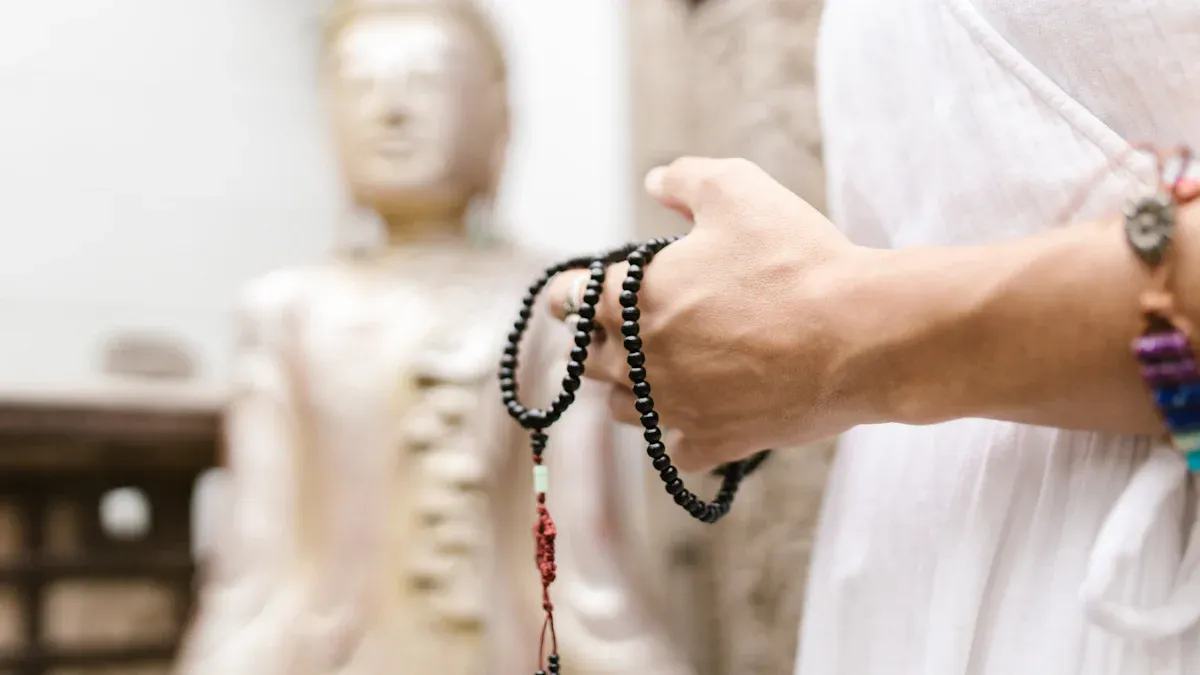
Mala beads are important in Hindu spiritual life. People in India have used them for more than 3,000 years. Hindu sages first used mala beads for meditation and japa. Japa means saying a mantra or god’s name over and over. Each mala has 108 beads. This number is very special in Hinduism.
The number 108 stands for harmony in the universe. It links a person’s mind to the universe’s energy.
In yoga, 108 energy channels meet at the heart chakra. This helps people wake up spiritually when they repeat mantras.
Ayurveda says there are 108 important spots in the body. These are called marma points.
The Sanskrit alphabet has 54 letters. Each letter has a male and female side, so there are 108 in all.
Hindu philosophy has 108 main Upanishads. These are important spiritual books.
People use mala beads to count prayers or mantras. This helps them pay attention and not get distracted. Moving from bead to bead keeps their mind on the prayer. Mala beads help people feel calm and connected when they meditate. Many Hindus think mala beads bring them closer to god and help them find peace.
Mala beads are not just tools. They show spiritual growth and devotion.
Buddhist Prayer Beads
Buddhist monks started using mala beads around the 5th century BCE. They learned about mala beads from Hindus and made them part of their own practice. Buddhist mala beads also have 108 beads, but the meaning is different. In Buddhism, the 108 beads stand for 108 desires people try to overcome.
Mala beads are important in Buddhist meditation. People use them to count mantras, which are special words or phrases. Each bead means one time they say the mantra. This helps the mind stay calm and focused. The beads help guide people through meditation and remind them of their goal.
People use mala beads to count mantras when meditating.
Mala beads help them reach a higher state of mind.
They support spiritual growth and mindfulness.
Buddhist and Hindu mala beads look alike, but they mean different things. The table below shows some differences:
Aspect |
Hindu Mala Beads |
Buddhist Mala Beads |
|---|---|---|
Number of Beads |
108, showing cosmic meaning and unity |
108, showing the 108 desires to overcome |
Symbolism |
Shows the universe and connection to God |
Shows the obstacles to enlightenment |
Chanting Purpose |
Each chant brings one closer to the divine |
Each chant helps to overcome human passions |
Mala beads help Buddhists stay focused and mindful. Each bead is a step toward enlightenment. As Buddhism spread, mala beads spread across Asia too. Today, people everywhere use mala beads for meditation, mindfulness, and spiritual growth.
Hindu and Buddhist prayer beads both use mala beads, but each group gives them its own meaning and use.
History of the Rosary and Christian Traditions
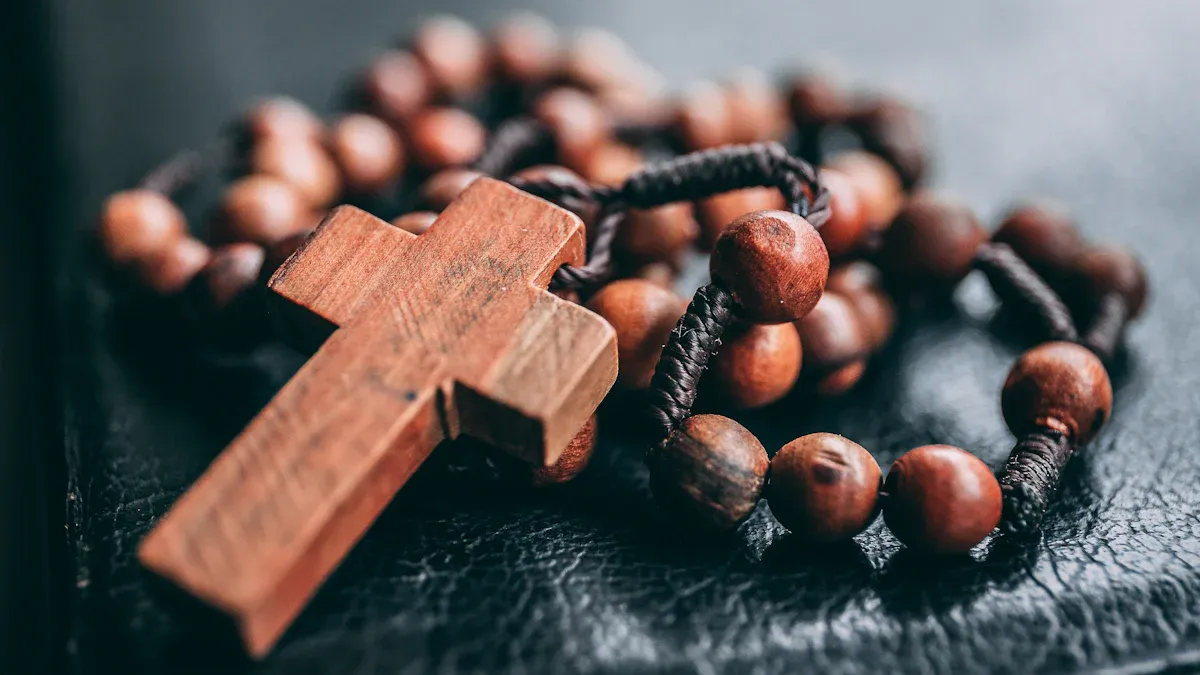
Origins of Rosary Beads
The rosary has a long history in christian faith. Early christian monks used stones to count prayers. Later, Irish monks made prayer groups to say all 150 psalms. People started using the hail mary prayer instead of psalms. This change happened in the 11th and 12th centuries.
St. Dominic is often connected to catholic prayer beads. In 1221, he had a vision of the Blessed Mother. This vision made him share the rosary with others. After St. Dominic, the rosary changed its structure. The mysteries of the rosary became important for reflection. These mysteries help people think about jesus’ life. In 1571, the Battle of Lepanto was a big event. Pope Pius V told people to pray the rosary for victory. After they won, the Feast of the Holy Rosary started in 1572.
Year/Event |
Description |
|---|---|
1221 |
St. Dominic is said to have created the rosary after seeing the Blessed Mother. |
1453 |
Constantinople fell, and people used the rosary for protection. |
1571 |
The Battle of Lepanto happened; Pope Pius V asked people to pray the rosary. |
1572 |
Pope St. Pius V started the Feast of the Holy Rosary after the victory. |
The mysteries of the rosary help people remember jesus and mary’s lives. Each group of beads stands for a mystery. Catholics say the hail mary, the Our Father, and the Glory Be as they move along the beads. The mysteries help people think about jesus’ birth, teachings, suffering, and rising from the dead. Praying the rosary brings people closer to god and makes their faith stronger.
The rosary changed over time. The mysteries and the hail mary prayer made it more special. These changes helped people feel closer to jesus and mary.
Anglican Prayer Beads
Anglican prayer beads are newer. In the 1980s, Reverend Lynn Bauman and others in the United States wanted a new way to pray. They made a simple set of prayer beads with thirty-three beads. This number stands for the years jesus lived. Anglican prayer beads are not like catholic prayer beads. They have four groups of seven beads called weeks, with bigger beads in between.
Feature |
Catholic Rosary Beads |
Anglican Prayer Beads |
|---|---|---|
Structure |
Has 50 Blue Decade Beads and Red Decade Beads |
Has four strands of beads |
Use |
Used for prayer about Gospel events |
Used for simple prayer devotions |
Historical Origin |
Given to Saint Dominic, became popular in Medieval Europe |
Started recently as an alternative |
Complexity of Prayers |
Has special prayers for the Rosary |
Can use many simple prayers |
Representation of Psalms |
Each Blue Decade Bead stands for a Psalm |
Does not stand for Psalms |
Anglican prayer beads give people a simple way to pray. People can use the hail mary, the Lord’s Prayer, or other prayers. Anglican prayer beads do not use the mysteries of the rosary. Still, the beads help people focus on jesus and their faith. Both catholic and Anglican prayer beads help people pray and show devotion. Each group uses them in their own way.
Prayer Beads in Islam and Sikhism
Islamic Misbaha
Muslim prayer beads, called misbaha or tasbih, play an important role in Islamic worship. People use them to count praises and prayers, helping them focus during dhikr, which means remembering god. The tradition of using muslim prayer beads goes back to the time of the Prophet Muhammad. His daughter, Fatimatuz-Zahra, used knots on a string to keep track of her prayers. Over time, these knots became beads, showing the practical side of Islamic spiritual practice.
A misbaha usually has 33 or 99 beads. Each bead stands for a name or praise of Allah. When a misbaha has 99 beads, it often includes a marker bead after every 33 beads. This marker helps the person know when to change the praise or prayer. Moving the beads between the fingers allows the worshipper to keep count without losing focus.
Muslim prayer beads help people remember to praise Allah.
The beads make it easier to keep track of prayers during worship.
The use of beads supports a calm and focused mind.
Sikh Mala
Sikhism also uses prayer beads, called mala, as a tool for meditation and chanting. Sikh mala come in different forms and bead counts. Some malas have 108 beads, while others have 58, 18, 10, or 7 beads. Sikhs may wear a long mala over one shoulder, use a rigid steel mala, or keep a short mala on the wrist or in a pocket. The design and number of beads can change, but the purpose stays the same: to help the person focus on repeating the name of god.
Type of Mala |
Description |
|---|---|
Chain |
A long mala may have 108 or other numbers of steel or iron prayer beads, worn or carried looped over one shoulder. |
Rigid |
A rigid steel mala with steel or iron prayer beads of one size may have various counts like 58, 18, 10, or 7 beads. |
Short Mala |
Worn looped over the wrist like a bracelet, or kept in a pocket or pouch when not in use. |
Both muslim prayer beads and Sikh mala use special numbers of beads. In Islam, 99 beads stand for the names of Allah. In Sikhism, 108 beads help count mantras and keep the mind on the chant.
Religion |
Symbolic Number of Beads |
Purpose of Beads |
|---|---|---|
Islam |
99 |
Used for chanting praises to Allah and counting names. |
Sikhism |
108 |
Used for counting mantras and focusing on the chant. |
Prayer beads in both religions help people stay focused during spiritual practice. They support mindfulness and devotion, making it easier to connect with god.
Symbolism and Modern Use
Materials and Numbers
People pick different materials for prayer beads. They do this because of tradition and meaning. Each material has its own special meaning:
Wood means being steady and strong. It helps people feel close to nature.
Seeds and nuts stand for new beginnings and growth. They remind people about life’s changes.
Gemstones and crystals have special powers. Many think these stones help with healing and focus.
Bone and ivory show that life does not last forever. They remind people about life and death.
Metal means strength and safety. Some people think it connects them to something higher.
Glass and ceramic can have special designs or symbols.
Bodhi tree wood is very important in Buddhism. It helps people remember Buddha’s enlightenment.
Numbers are also important in spiritual practice. The number 108 is used in Hinduism, Buddhism, and Jainism. Hindus think 108 is the number of Upanishads. Buddhists link 108 to feelings from the senses. Jainism uses 108 to show the many ways karma can come into life. In Japan, people ring bells 108 times for the new year. This helps them avoid temptations. Muslims use 99 beads to honor the names of god. Christians often use 33 beads to remember how long Jesus lived. (For a deeper exploration of these symbols, our article on Understanding Prayer Beads: Their Historical Roots and Symbolic Meanings offers great insight.)
Contemporary Practice
Today, prayer beads help people in many ways. They help people be mindful and feel better. People use them to calm down and focus on breathing. This can lower stress and help people feel good. Studies show praying the rosary helps people feel less sad and more hopeful. It also helps people care about others and deal with hard times. ( If you're new to this practice, our Beginner’s Guide to Using Prayer Beads in 2025 is an excellent starting point.)
Prayer beads are now used by people of many faiths and even by those who are not religious. People use them for personal growth and meditation. Malas are now popular as spiritual jewelry. They help people stay disciplined and mark their spiritual journey. Many people find that prayer beads help them focus and connect with themselves, even if they are not religious. (To get the most out of your practice, discover our guide on How to Use Prayer Beads for Enhanced Meditation Techniques.)
Prayer beads still bring people together from different cultures. They give comfort and help people focus during spiritual practice.
Prayer beads have been important in spiritual life for a very long time.
Many religions use them for prayer and meditation.
People in different places give them to family members. They share stories and make strong bonds.
The look and what they are made of can change. But their main job is always to help people focus and feel connected.
In Sufi tradition, there is always one bead missing. This reminds people that some things about the divine are still unknown.
Prayer beads keep changing over time. They show how people are different but also alike in their spiritual lives.
Pieces That Carry This Intention
Beads meant to be handled while you practice, not just worn.


FAQ
What are prayer beads used for?
People use prayer beads to count prayers, mantras, or breaths. The beads help them focus during meditation or worship. Many believe the beads bring calmness and support spiritual growth.
Do all religions use the same number of beads?
No, different religions use different numbers. For example, Hindu and Buddhist malas often have 108 beads. Islamic misbaha usually have 33 or 99 beads. Christian rosaries can have 59 or 33 beads.
Can anyone use prayer beads?
Yes, anyone can use prayer beads. People from many backgrounds use them for prayer, meditation, or mindfulness. Some use them for stress relief or as a reminder to stay calm.
What materials do people use to make prayer beads?
People use wood, seeds, gemstones, glass, or metal. The choice often depends on tradition or personal meaning. Some materials, like Bodhi tree wood, have special spiritual value.
How do prayer beads help with mindfulness?
Prayer beads give the hands something to do. Moving from bead to bead helps the mind stay focused. This practice can make meditation or prayer easier and more peaceful.
See Also
How to Use Prayer Beads for Enhanced Meditation Techniques
Beginner’s Guide to Using Prayer Beads in 2025
Understanding Prayer Beads: Their Historical Roots and Symbolic Meaning