
The Second Spring: Transforming Midlife with Taoist Practice

Midlife brings lots of changes in life, often prompting individuals to reflect on their purpose and direction. Many women feel worried as they notice their bodies transforming, leading to uncertainty about their emotions. However, Taoist wisdom teaches that aging can be a positive experience. It offers us new opportunities and helps us cultivate inner strength. What if transforming midlife could be akin to experiencing a second spring? By shifting your perspective on midlife, you can view life as a journey filled with fresh possibilities and renewed hope.
Key Takeaways
Midlife can be a time to start fresh. Think of the 'Second Spring' as a way to see getting older as a chance to grow.
Taoist practices like Qigong and Tai Chi help your body and mind feel better. Doing them often can lower stress and make you healthier.
Looking at yourself by journaling helps you learn about your life. Writing things down can make your thoughts clear and help you grow.
It is important to accept change. Taoism says every part of life has its own lessons. This helps you feel calm when things change.
Having support from others matters a lot. Sharing your stories with people can give you hope and strength during midlife changes.
What Is the Second Spring?
Taoist Roots of Second Spring
Taoist philosophy says the second spring is a time for mature women to feel renewed. This idea comes from old teachings that respect change and nature’s cycles. Taoism says each part of life has its own wisdom. The second spring is when people move from being young to learning more about themselves. Lao Tzu and Chuang Tzu, who are Taoist thinkers, tell people to accept change and live in balance with nature. They think change is normal in life. Taoism compares this time to spring coming after winter, which brings new life and energy.
A look at Taoist ideas and other traditions shows that change and renewal are important everywhere. For example:
Taoist Concept |
Related Concept in Other Traditions |
|---|---|
non-being (non-being) |
Emptiness is important in Buddhism |
natural authenticity (natural authenticity) |
Human nature in Western philosophy |
transformation (transformation) |
Spiritual exercises in Augustine's works |
Taoism cares about growing both the body and the spirit. This helps mature women see midlife as a time to grow as a person.
Meaning in Chinese Medicine
Traditional Chinese Medicine (TCM) sees the second spring as a special time for women. TCM tells mature women to respect this new part of life and focus on getting better. The second spring is not the end. It is a new start. It gives women a chance to find their own wisdom and care for their mind, body, and spirit. TCM thinks menopause is a good and strong change. At this time, women start to care more about themselves and their own growth. This time helps mature women get back their energy and happiness.
Dr. Maoshing Ni, who knows a lot about Chinese medicine, shares good ideas about the second spring. He says midlife is a time for new beginnings and feeling complete. Mature women can try new hobbies and things they enjoy. The second spring is a big change that helps women welcome new chances in life.
Midlife Challenges and New Perspectives
Physical and Emotional Changes
Many women go through body and mood changes in midlife. Menopause can cause hot flashes, tiredness, and chest pain. Stress may show up as a fast heartbeat and feeling worn out. Hormone changes during peri-menopause can make anxiety and mood swings worse. Some women feel less angry as they get older. Others may find anger turns into sadness during menopause. People might learn to handle their feelings better in midlife. But sometimes, emotions can still be hard to control. Knowing about these changes helps women take care of themselves and feel better.
Breaking Western Midlife Stereotypes
In Western culture, people often think midlife means getting worse. Many see menopause and peri-menopause as bad things. This idea can make people scared and unsure. Society does not talk much about good things at this age. Most stories focus on losing things, not growing. Taoist philosophy gives another way to look at it. It says every part of life matters. Midlife can be a time to start fresh and learn about yourself. Taoism teaches people to accept change and see the wisdom that comes with getting older.
Opportunity for Growth
Midlife gives people special chances to grow. Studies show this time helps people heal from old problems and become stronger. The lifespan developmental perspective says midlife helps balance good and bad things. Peri-menopause and menopause can be times to think and make changes. People can use this stage to link their past and future. Family ties and new health habits help shape this journey. By learning about these changes, women can find new ways to grow and find meaning in midlife.
Transforming Midlife with Taoist Wisdom
Embracing Change and Wu Wei
Taoist teachings help people see midlife in a new way. Wu Wei is a main idea in Taoism. It teaches people to follow life’s natural rhythm. Instead of trying to control everything, people learn to trust what happens. Wu Wei is not about doing nothing. It means acting with the Tao and letting things happen. This helps women feel less stress when life changes.
Wu Wei does not mean you do nothing. It means you act with the Tao and do not force things.
People who use Wu Wei in midlife get many benefits. Trusting life’s flow helps people accept change. When people welcome new stages, they feel more peace. Dancing with life’s rhythm helps people enjoy midlife more.
Yin-yang is also important in Taoism. Yin means being open and quiet. Yang means being active and bright. Both are needed for balance. People learn to find flow between work and rest. Challenges and easy times both happen in life. The table below shows Taoist ideas for midlife change:
Principle |
Description |
|---|---|
Wu Wei |
Go with the flow and let actions happen naturally. |
Simplicity |
Remove things you do not need and focus on good friends. |
Balance |
Switch between being active and resting to stay healthy. |
(To explore more about Wu Wei, see Taoist Approach to Effortless Living Through Wu Wei.)
Cultivating Inner Strength and Balance
Changing in midlife means building strength inside and keeping balance. Taoist practices like Qigong, Tai Chi, and meditation help people feel better. These activities help both body and mind. Studies show Taoist practices lower stress and make people happier. The chart below shows how long people practice and how it helps their feelings.
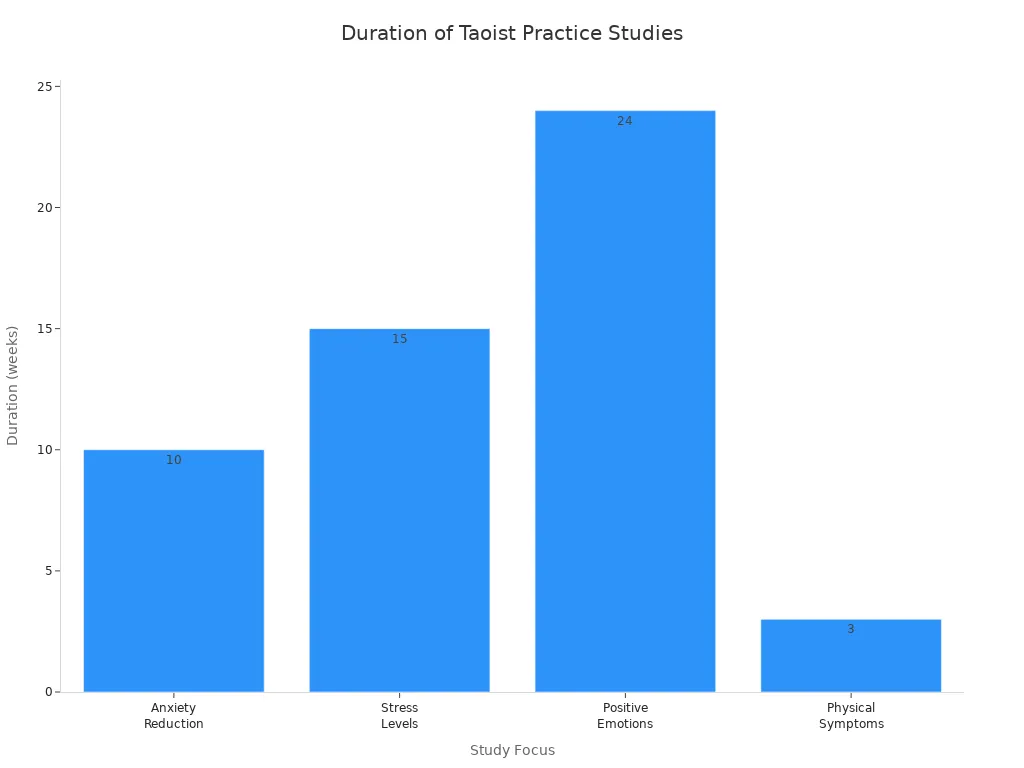
People who do Taoist movement and meditation feel less stress. Their bodies feel better too. They feel stronger and like they are starting fresh. Doing Qigong or Tai Chi helps the body change. Accepting life and learning to go with the flow helps with feelings. This shows that change in midlife is about mind, body, and spirit.
Qigong and Tai Chi give energy and help people feel calm.
Meditation helps people know themselves and feel new again.
Taoist practices help people balance work and rest.
Celebrating Wisdom and Creativity
Taoist wisdom tells people to enjoy their wisdom and creativity in midlife. Being like water means being flexible and open. This helps people be creative and wise. It also helps people feel new again. Yielding brings love and kindness, which are important for happiness later in life. Taoist teachings say creativity helps people heal and learn about themselves.
Being flexible and open helps people become wise and understand more.
Yielding brings love and kindness, which are needed for joy later in life.
Creativity helps people heal and learn about themselves.
People who follow Taoist ideas in midlife enjoy their wisdom and creativity. They change and feel more like themselves. Taoist teachings tell people to honor their journey and find balance. People learn to see their own energy. Celebrating wisdom and creativity starts a new time of growth and rebirth.
Practical Second Spring Practices
Meditation and Qigong
Meditation and Qigong are important Taoist practices for menopause. These help women relax and support their body’s energy. Qigong uses gentle movements to keep people strong and flexible. Studies show women who do Qigong for 30 minutes each day sleep better. They also have fewer menopause symptoms. Both Meditation and Qigong lower stress and help with emotions. Focusing on breathing and the mind brings peace. Moving and meditating often helps people feel healthy and heal in midlife.
Qigong and Tai Chi help blood flow and make you flexible.
Meditation helps calm thoughts and keeps emotions steady.
Doing these every day makes you feel better overall.
(If you want to try meditation, check out Fast and Effective Meditation for Stress Relief in 2025.)
Herbal Support and Taoist Rituals
Herbal remedies are important in Taoist ways after menopause. Taoist healers use herbs to help the body change and heal. The table below lists some herbs and what they do:
Herb |
Benefit |
|---|---|
Cinnamon |
Blood glucose balancing |
Hawthorn Berry |
Blood glucose balancing |
Astragalus |
Immune enhancing actions |
Reishi Mushroom |
Immune enhancing actions |
Angelica |
Estrogen modulating properties |
Rehmannia Root |
Estrogen modulating properties |
Horny Goat Weed |
Libido boosting benefits |
Maca Root |
Libido boosting benefits |
Taoist rituals like lighting incense or saying thanks make a calm space. These rituals help people heal and think in a positive way.
Self-Reflection and Journaling
Self-reflection and journaling are good for self-care during menopause. Writing about your life helps you find your true self. This helps people accept change and find new goals. Journaling lets women look at memories and roles, which brings more happiness. Thinking about yourself helps you heal and grow during this time.
Journaling helps people see things clearly and enjoy their journey.
Support from Taoism and Manifest
Taoism and Manifest gives help to people in midlife. Programs like Taoist Internal Alchemy and Taijiquan teach about energy and movement. Memberships help people learn Taoist ideas and inner practices. Free things, like Qigong exercises, help with health and energy. Learning materials and certified products help women find balance and peace during menopause and after.
Real Stories of Midlife Transformation
Personal Journeys of Renewal
Many women share stories about menopause changes. These stories show how renewal happens in real life.
Antoinette Blake lost her job at IBM at age 55. She did not stop trying. She became a blogger and started her own business. She won awards and helps other women use social media. Her story shows what is possible in the second spring.
Other women talk about finding new purpose during menopause.
"Every woman feels something deep inside at some point. In sadness, something special wakes up. A new me started to grow."
These stories show how people change and find new meaning. They show what happens when someone welcomes change.
Inspiration for Your Second Spring
What can we learn from these stories? Many women see menopause as a time to grow. It is not the end. It is a time to discover new things. Their stories share common ideas:
Accepting change and letting go of old things
Caring for body and mind with Taoist practices
Finding new purpose in later years
Community and friends help people age well
Using Taoist ideas in daily life
Gaining wisdom for a happy and balanced life
What do these stories teach us? They show women can make midlife a second spring. This time can break old ideas. It helps women celebrate their strength and dreams. The second spring is a time to start fresh, not to give up.
Midlife gives women a special chance to grow and feel new. Taoism says aging is not losing something. It is changing into something better. If you accept change and let go of old things, you can feel stronger. Finding peace now helps you discover new strength. Experts say you should rest, eat healthy foods, move gently, and care for your feelings. Doing Tai Chi for a long time helps you move better and keeps you steady. Trying Taoist practices or using Taoism and Manifest resources can help you start this journey. You can change at any age, and you are never alone.
Practice |
Long-Term Benefit |
|---|---|
Tai Chi |
Better mobility and balance |
Meditation |
Greater emotional stability |
Herbal Support |
Enhanced overall well-being |
Pieces That Carry This Intention
A few pieces from the shop that sit close to what this article is about.


FAQ
What is the Second Spring in Taoism?
The Second Spring is a time when people feel new again in midlife. Taoism says this stage brings fresh energy and helps people grow. It teaches that change is normal and part of life.
What Taoist practices help during menopause?
Taoist practices like Qigong, Tai Chi, and meditation help with health. These activities are good for both the body and the mind. They also help people feel calm and keep balance.
What can women expect from Taoist rituals?
Women can find peace and focus from Taoist rituals. Doing things like lighting incense or saying thanks makes a quiet space. These simple acts help people heal and take care of themselves.
What makes Taoism different from other self-help methods?
Taoism tells people to follow the way of nature. It cares about balance and slow, gentle change. This helps people accept each part of life without pushing too hard.
What resources does Taoism and Manifest offer for midlife?
Taoism and Manifest gives learning tools, certified products, and guided practices. These things help people stay balanced and get support in midlife.