
What is the history and meaning of prayer beads

You may ask why people use prayer beads or what they mean. Prayer beads are strings of beads that help you count prayers or chants. They also help you count meditations. Almost every big world religion uses some kind of counted prayer. This includes Hinduism, Buddhism, Islam, Christianity like the rosary, Sikhism, and more. You can find prayer beads in many cultures. Some examples are Catholicism and the Orthodox Church. Learning about their history helps you see how people connect with faith over time and in different places.
Key Takeaways
-
Prayer beads help people count prayers. They also help people focus during meditation. Many religions use them, like Hinduism, Buddhism, Islam, and Christianity.
-
People make prayer beads from different things, like wood, seeds, and gemstones. Each material means something special in different cultures.
-
Using prayer beads can help lower stress. They also help people pay attention to the moment. Moving each bead can help you feel calm. It can also help you feel closer to your faith.
-
The number of beads is often important. For example, 108 beads in Hinduism and Buddhism stand for spiritual goals and the universe.
-
Prayer beads have a long history that goes back thousands of years. They have changed in different cultures and religions. But their main use is still the same: to help with prayer and meditation.
Prayer Beads Explained
What Are Prayer Beads
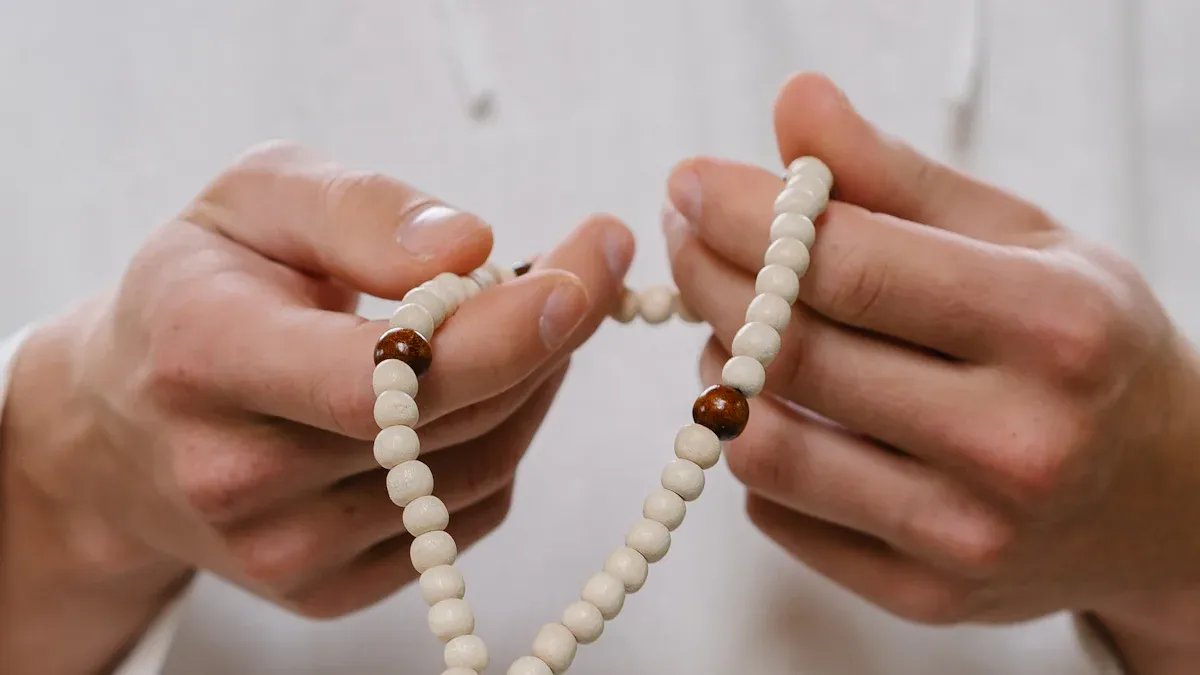
Prayer beads come in many different shapes and sizes. People use them to count prayers, chants, or mantras. Many religions use prayer beads. Christianity uses the rosary. Buddhism, Hinduism, and Islam also use them. The materials for prayer beads show the culture and beliefs of each group. Some common materials are:
-
Simple string
-
Precious stones
Prayer beads can look different in shape and size. The table below shows how different groups use different materials. It also shows what each material means.
|
Material |
Traditions Involved |
Symbolic Meaning |
|---|---|---|
|
Wood |
Buddhist, Hindu, Christian |
Grounding, stability, connection to nature |
|
Seeds and Nuts |
Hindu, Buddhist, Jain |
Growth, renewal, cycle of life |
|
Gemstones |
Various spiritual practices |
Unique metaphysical properties |
|
Bone and Ivory |
Tibetan Buddhist, Hindu |
Impermanence, cycle of life and death |
|
Metal |
Hindu, Buddhist, Christian |
Strength, protection, divine connection |
|
Glass and Ceramic |
Various traditions |
Spiritual symbols, mandalas, meaningful designs |
|
Bodhi Tree Wood |
Buddhist |
Revered for its association with enlightenment |
How Prayer Beads Are Used
You might want to know how to use prayer beads. Many people use them to help focus and keep track of prayers. Here are some easy steps for using prayer beads:
-
Pick beads that feel good in your hand.
-
Hold the beads between your thumb and finger. Start with the bead next to the guide marker.
-
Say your prayer or mantra for each bead.
-
Move to the next bead after each prayer.
-
Sit quietly and think when you finish.
Prayer beads help you focus and pay attention. Moving the beads can help you relax and feel less stressed. They also help you stay mindful and present. Many people say prayer beads help them feel closer to their faith. In many religions, prayer beads like the rosary are very important in rituals.
Tip: Try using prayer beads when you pray or meditate. You might feel calmer and more connected.
History of Prayer Beads
Ancient Origins
Prayer beads have been around for thousands of years. Archaeologists found beads in old places like Mesopotamia and the Indus Valley. These beads were not only for decoration. People used them in spiritual and ritual ways. The table below lists some important finds:
|
Evidence Description |
Civilization |
Date/Period |
|---|---|---|
|
Etched carnelian beads with stepped patterns and guilloché designs |
Mesopotamia |
Akkadian Empire or Ur III period |
|
Jewelry components from the Indus, Central Asia, and Northern-eastern Iran |
Susa, Akkadian Empire |
Ur III period |
|
Oval-shaped carnelian beads with guilloché pattern |
Susa excavations |
Akkadian Empire or Ur III period |
|
Etched carnelian beads thought to be imported from the Indus Valley |
Ancient Egypt |
Late Middle Kingdom c. 1800 BCE |
Mark Kenoyer is a researcher who studied these beads. He learned about the tools people used to make them. Trade routes for bead materials show how cultures met and shared ideas. By looking at beads, you can see how daily life and the environment shaped the Indus Valley Civilization.
Spread Across Religions
Prayer beads spread to many religions over time. Hinduism started using prayer beads in India around 500 BC. Buddhists began using beads for meditation and prayer. Islam later used beads called Misbah or Tasbih. These usually have 99 or 33 beads for the names of Allah. Christianity made the rosary for special prayers and meditation.
|
Religion |
Origin of Prayer Beads |
Key Features and Adaptations |
|---|---|---|
|
Hinduism |
Traced back to 500 BC in India |
Known as Japa Mala, used for chanting mantras. |
|
Buddhism |
Concept likely borrowed from Hinduism |
Adapted the use of beads for meditation and prayer. |
|
Islam |
Borrowed from Buddhism |
Known as Misbah or Tasbih, with 99 or 33 beads representing names of Allah. |
|
Christianity |
Developed from early Catholic practices |
Known as rosary, used for specific prayers and meditations. |
Early Christian Desert Fathers lived around the 3rd century A.D. They counted prayers with pebbles. Later, they put beads on cords. This became a tradition in Christian monastic life.
Evolution Over Time
Prayer beads changed a lot over the years. Hinduism started using them about 2,900 years ago. Buddhists and Muslims also began using prayer beads. Christian rosaries became common in the Middle Ages.
-
Hinduism started using prayer beads about 29 centuries ago.
-
Buddhists and Muslims adopted the practice.
-
Christian rosaries became popular in the Middle Ages.
People use prayer beads to help say prayers or mantras. This helps them focus and feel closer to their faith. In Hinduism, the mala has 108 beads, which is a special number. The word "bead" comes from Old English and means "to pray." The round shape of prayer beads stands for the never-ending cycle of life.
Designs and materials changed over time. Early Christians used simple pebbles. Later, they used beads on cords. By the Middle Ages, rosaries spread across Europe. Pope Pius V made the rosary official in 1569. Between the 12th and 15th centuries, rosaries became fancier. The Pater bead was often more decorated than the Ave beads. Craft guilds made beads from amber, precious stones, and glass. The word "gaudi" described fancy beads, showing a move from simple counting to decoration.
Note: The history of prayer beads shows that people from many cultures and religions wanted to connect with their faith. Materials, designs, and uses changed, but the main purpose stayed the same: to help people focus during prayer and meditation.
Prayer Beads in Religions
Hinduism and Buddhism
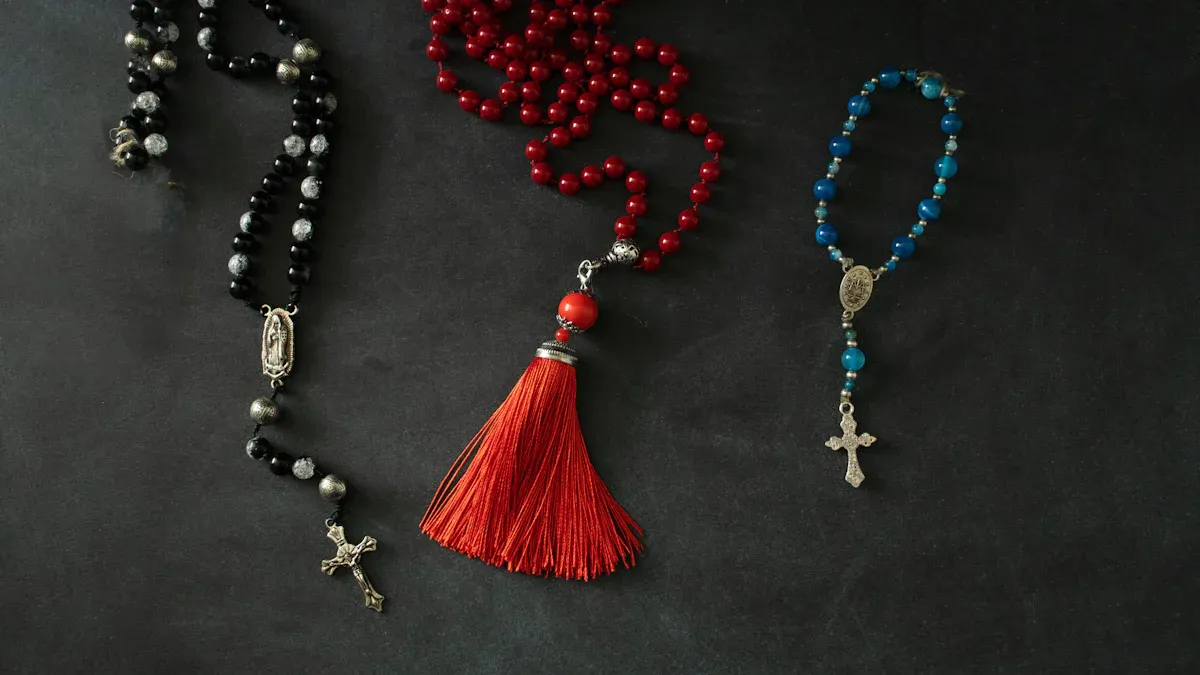
Hinduism and Buddhism both use prayer beads. These beads are called mala beads. People use them to count mantras or prayers. This happens during meditation. Most malas have 108 beads. Some Buddhist malas have 18, 27, or 54 beads. The number 108 is very important. In Buddhism, it stands for 108 earthly desires. You must overcome these to reach enlightenment. In Hinduism, 108 means the Upanishads, names of deities, and energy channels.
|
Tradition |
Number of Beads |
Ritual Use |
|---|---|---|
|
Buddhist |
108 (also 18, 27, 54) |
Used for meditation and daily devotion |
|
Hindu |
108 |
Used for chanting mantras and meditation |
When you use mala beads, you touch each bead as you pray. The round shape shows the cycle of life. The Guru Bead is the biggest bead. It marks where you start. It also honors the teacher-student bond. The tassel at the end connects you to the divine.
Tip: Using prayer beads in these religions helps you focus. It also makes your spiritual connection stronger.
Islam
Muslims use prayer beads called Misbaha or Tasbih. These beads usually have 33 or 99 beads. Each bead helps you count praises to Allah. The practice is called Dhikr. You repeat phrases like "SubhanAllah," "Alhamdulillah," and "Allahu Akbar." You say each phrase 33 times. You move a bead for each time you say it. This helps you stay focused and mindful.
|
Component |
Description |
|---|---|
|
Bead Counts |
33, 99, or 100 beads for specific counts in dhikr |
|
Dividers |
Larger beads at intervals to show progress |
|
Imam/Alif Bead |
A special bead marking the starting point |
|
String |
Made from strong materials for daily use |
Moving the beads in your hand feels calming. It helps you pay attention to your prayers.
Christianity
The rosary is the most famous prayer bead in Christianity. Catholics use rosary beads to say prayers. These prayers include the Our Father, Hail Mary, and Glory Be. The rosary changed over time. St. Dominic got the rosary in 1221 AD. Later, the Mysteries were added.
|
Year |
Event Description |
|---|---|
|
1221 AD |
St. Dominic receives the rosary from Mary and spreads its use. |
|
Medieval |
People begin using beads to count 150 Our Fathers. |
|
15th Century |
The rosary gains its current structure with decades and meditations. |
Other Christians, like the Eastern Orthodox Church, use prayer ropes. These ropes have knots instead of beads. They help you repeat the Jesus Prayer. Protestants also use prayer beads. This shows that many Christian groups use prayer beads. Rosary beads help you think about Jesus' life. Prayer ropes help you find inner peace.
Other Traditions
Many other religions and cultures use prayer beads. Orthodox Christians use Komboskini or Chotki. These have knots for the Jesus Prayer. In Africa, some people use beads for stories and honoring ancestors. Each group changes the practice to fit their beliefs.
|
Tradition |
Unique Features |
|---|---|
|
Buddhist Prayer Beads |
108 beads for mantra recitation and contemplation |
|
Orthodox Christian Beads |
Knots for the Jesus Prayer |
|
Muslim Prayer Beads |
99 beads for Dhikr and personal prayers |
|
Christian Rosaries |
Used for reflecting on Jesus' life |
|
Traditional African Beads |
Used for ancestral communication and cultural heritage |
In all these groups, prayer beads help you count and focus. They support your spiritual practice. The number of beads and rituals may change. But the main goal is the same. Prayer beads guide you in prayer and meditation.
Meaning of Prayer Beads
Spiritual Significance
Prayer beads are not just for counting. They help you feel calm and focused when you pray or meditate. Many people say moving each bead helps them feel steady. This action keeps your mind on the present moment. When you use prayer beads, you can let go of stress and pay attention to your prayers.
-
Beads help you keep track of prayers, so you can focus on meditation.
-
Touching each bead makes you feel steady during japa, or repeating prayers.
-
Mala beads have helped people feel less anxious for a long time and are used as worry beads.
-
They remind you to take care of yourself and keep up with meditation.
-
Moving beads through your fingers feels relaxing and helps you build good habits.
-
Mala beads help you grow spiritually and reach higher thoughts.
Many people think prayer beads make meditation and prayer easier. The rosary, for example, helps you follow each step of your prayer. You can use prayer beads to set goals, wish for good things, or just find peace in your day.
Tip: Hold your prayer beads when you feel worried. You might notice your mind gets quieter and your breathing slows down.
Symbolism and Purpose
Prayer beads have special meaning in many religions. The number of beads is important. In Buddhism and Hinduism, 108 beads stand for spiritual goals or the whole universe. In other religions, the number connects to good qualities, energy points, or holy places.
|
Tradition |
Symbolic Meaning |
|---|---|
|
Buddhism |
108 earthly desires you must overcome for enlightenment. |
|
Jainism |
108 virtues for spiritual purity and freedom from being born again. |
|
Sikhism |
108 important places linked to Sikh leaders. |
|
Yogic/Tantric |
108 energy centers in the body for spiritual awakening. |
|
Traditional Chinese Medicine |
108 pressure points for healing and energy flow. |
|
Mathematical |
108 shows sacred shapes and balance in the universe. |
|
Cosmic Unity |
1 means divine, 0 means emptiness, 8 means forever, showing the whole universe. |
|
Interconnectedness |
Each bead is part of the whole, showing everything is connected. |
|
Sacred Geometry |
The digits in 108 add up to 9, which stands for enlightenment and love. |
The materials and colors of prayer beads also have meaning. You might pick Bodhi seeds for enlightenment or Rudraksha for calmness. White beads mean purity, red means kindness, and blue means wisdom.
|
Material |
Symbolic Meaning |
|---|---|
|
Bodhi Seeds |
Enlightenment |
|
Rudraksha |
Calmness |
|
Sandalwood |
Purification |
|
Lotus Seeds |
Spiritual Growth |
|
Gemstones |
Healing |
|
Bone |
Impermanence |
|
Color |
Symbolic Meaning |
|---|---|
|
White |
Purity |
|
Red |
Compassion |
|
Green |
Healing |
|
Blue |
Wisdom |
|
Yellow |
Joy |
|
Black |
Protection |
|
Purple |
Spiritual Insight |
Prayer beads are more than just tools. They remind you of your spiritual path and your link to something bigger.
Prayer beads remain an important part of spiritual practice for many people today. You can use them to focus your mind, calm your thoughts, and deepen your connection during prayer. Many find that handling each bead helps them feel present and peaceful.
-
Prayer beads help you stay mindful and centered.
-
The circular shape reminds you of wholeness and unity.
|
Book Title |
Description |
|---|---|
|
A Bead and a Prayer: A Beginner's Guide to Protestant Prayer Beads |
Learn how to use Protestant prayer beads. |
|
Bead by Bead: The Ancient Way of Praying Made New |
Discover new ways to pray with beads. |
If you want to learn more, museums and books offer great ways to explore the history and meaning of prayer beads.
Pieces That Carry This Intention
Beads meant to be handled while you practice, not just worn.


FAQ
What are prayer beads made from?
You can find prayer beads made from wood, seeds, gemstones, bone, metal, or glass. Each material has a special meaning. For example, Bodhi seeds stand for enlightenment, and Rudraksha seeds help you feel calm.
How do you use prayer beads for meditation?
Hold the beads in your hand. Move one bead at a time while you say a prayer or mantra. This helps you focus and stay present. You can use this method for meditation or prayer.
Do all religions use the same number of beads?
No, each religion uses different numbers. Hindu and Buddhist malas often have 108 beads. Muslim Misbahas have 33 or 99 beads. Christian rosaries use sets of ten beads called decades.
Can you wear prayer beads as jewelry?
Yes, you can wear prayer beads as necklaces or bracelets. Many people do this to keep them close. Some believe wearing them brings protection or reminds you to stay mindful.